Sequoia Park Integrated Pest Management call 11/272023

Melanie Thank you so much for calling me Monday evening November 27th about Sequoia’s pesticide use. I was surprised. And I must admit it wasn’t until you mentioned your boss that I realized that you were in the Integrated Pest Management (IPM) department at Sequoia.

I did understand that you were going to email me your contact information and a few answers before now but despite having you read my email address back to me, I must have muddled it when I gave it to you.

I have also been trying to get contact information for the IPM department from Yosemite for almost 3 months now. Actually Sequoia also failed to respond in any way to my first request for pesticide usage information, but I had not yet discovered for myself the federal requirement for IPM departments. In half a dozen contacts with Yosemite, their superintendent’s office failed to even once mention or later admit that an IPM contact even existed. Once I had discovered that an IPM Department /contact was legally required by the parks, Yosemite then ignored specific requests for a contact. And to this day I do not have a contact for the Yosemite IPM Department.
You called them your “sister Park” so would it be possible for you to provide Yosemite’s IPM Department contact to me? The very same is true for the Everglades. This really just doesn’t look good to me at all — and actually _any_ of my friends — really.

I told you on our call that I am a little bit aware of, and very sympathetic towards, the deep issues the parks are trying to solve. I dearly love biology and follow many, many aspects of it.

It was very kind of you to explain how dedicated your IPM department is and how little pesticide use there actually is in the park. And how there is absolutely no need for me to worry at all. As I said to you, I believe that the parks could have been less antagonistic to me. Such as the lying by omission by the Yosemite Park’s superintendent’s office described above. I would certainly not be as concerned as I am now _if_ — as you told me — something like 80% of the pesticide use was for, and in, Park buildings. But of course the only way for me to understand _and verify_ that would be to get the data that I’m requesting. I am asking again for the public documents detailing all pesticide use in the Sequoia Park for the last 5 years (names, amounts, locations, and if applied by a contractor their license information) Melanie, sorry, I upped the time frame from what I told you on the phone in order to get some data before the covid changes that you pointed out in our chat. I hope your boss gives you the approval you thought he might to give these public documents to me.

Thank you for also explaining about the certification program. Does everyone in the IPM Department have to be certified? Is the certification program specific to the NPS? Who runs it (the IPM certification program)? And could you describe the different certification levels again? Or would there be a public internet page that describes this key aspect of the IPM Department? It is required by law but I don’t want to be a problem ๐Ÿ˜Š I would also really like to know who created the training videos that I have seen?

I have a contact who tried to send me a variety of links to IPM training but unfortunately many of the links required passwords and login information. Do you think it might be a really good idea to have a public /anonymous login to this system as a way of being more open /transparent about all aspects of pesticide use in Our National Parks?

Again you were _very_ helpful and your dedication to the park was clear and obvious to me. At the same time, I was a little disappointed and depressed that you were unaware that glyphosate was originally patented as an antibiotic and damages the soil food web. Would you have any idea how many other important details about the pesticides being used in Sequoia, the Everglades, or Yosemite have also not managed to get through the “training” administrators? Thank you so much for protecting our endangered species!

I am curious about Sequoia’s use of green pesticides such as neem oil. How would you compare the amounts of neem oil used to the amounts of glyphosate products you told me about? Far less, roughly equal, far more?
Is Sequoia National Park using any molt inhibitors of any kind to control mosquitoes?

You had mentioned talking to your boss about getting me the actual full data that I am requesting. Could you provide me his name (I’m not being chauvinistic, you mentioned that it was a he ๐Ÿ˜‰) and his contact information?

And one last question a bit outside of your actual expertise so if you don’t know it is _okay_. I understand that the John Muir Project is concerned about and even suing Sequoia over the possible planting of Sequoia “seedling” material in the burned areas. I am wondering where is the online documentation as to how this material was grown, what laboratory they were grown in, and the specific organic material they were derived from? I am asking since, if the lawsuit is unsuccessful this Sequoia material would be with us for hundreds if not thousands of years. Do you think it might be better government transparency if the Sequoia Park had a better way of searching their website for this kind of information?

Melanie, I wish you and your husband the very best! Happy holidays!

Bob
www.puravidaaquatic.com/
www.puravidaaquatics.com/
310-429-8477

Spread the Good News Below: Permaculture!
Posted in Uncategorized | Leave a comment

Bullfrog – SAVE THE FROGS!

Source: Bullfrog – SAVE THE FROGS!

SAVE THE FROGS! Founder Dr. Kerry Kriger addressed the California Fish & Game Commissionโ€™s Wildlife Resource Committee on January 13th, 2022, to discuss the stateโ€™s bullfrog importation program. Each year, the California Department of Fish & Wildlife issues permits for the importation of over two million American Bullfrogs

There is utterly no reason to be importing bullfrogs into California! They do irreparable harm to our native wildlife. They eat our little native Pacific chorus frogs, baby birds, and other native species. If you actually want to do something for the environment other than throwing a little money to some organization that says they will do it for you then talk to the fishing game department expressing your disappointment that we are importing 2 million! bullfrogs into California every year.

Spread the Good News Below: Permaculture!
Posted in Uncategorized | Leave a comment

Looking back on a century of poisoning predators

Source: Looking back on a century of poisoning predators

Please read the article above. I promise you it will be eye-opening.

excerpt:
This year, for example, marks the 100th anniversary of the founding of the Bureau of Biological Survey. Congress created the agency a century ago to trap, poison and kill predators and “varmints” across the West. The result was an ecological holocaust of strychnine-ridden carcasses and indiscriminate destruction up the food chain. We tried to kill coyotes; we brought death to eagles instead.
The agency’s goal was to eliminate predators to foster game populations of deer and elk, and to reduce losses by stockmen who raised sheep and cattle.

Does this sound at all familiar to you in 2023?

Back in 1915, the words “ecology” and “environment” were unknown.

It seems that many of us are still struggling with these words.

Spread the Good News Below: Permaculture!
Posted in Uncategorized | Leave a comment

They tell you that grass smothers the tree and that you should spray grass killer around.

Guess where the grass killer was sprayed! ๐Ÿ˜†

www.puravidaaquatic.com/ www.puravidaaquatics.com/ 310-429-8477

Spread the Good News Below: Permaculture!
Posted in Uncategorized | Leave a comment

Sloppy, almost criminally poor approval of pesticide use by our national parks.


After 2 months of the National Park (Service???) refusing to give me any of their Integrated Pest Management data at all, I have acquired some through an alternate route.

</span

Summary of a PUPS data entry that is quoted further below:
The Integrated Pest Management (IPM) division approved aerial spraying of 10,000 leased acres with as much as 10 tons of a product that is known to be toxic and negatively affect native bees, native butterflies and the native wetland communities at and near the site, including an endangered fish species.
<Br

The material safety data sheet (MSDS) on the approved pesticides clearly states not to get it in waterways which certainly happened. This would affect food resources, if not have direct toxicity to the fry of the endangered fish in the area. The National Park Service is killing off the very base of the food chain for baby fish, baby dragonflies and many other beneficial aquatic organisms.

I believe this is just the tip of the iceberg as to why so many of our endangered species are struggling. It is highly likely that developing young animals are much more affected by the toxins being sprayed then adults.

The best to everyone here. I love you all, and your children and grandchildren too. I believe that poorly regulated pesticide use is the most hazardous thing to their future happiness and health. Beyond even climate change and that’s saying an awful lot.


I think this is literally the third data entry I looked at under a small fragment of the PUPS database I acquired. It is on leased land just like the issue with the fire under the 10 freeway in LA


I also wonder why the integrated Pest Management (IPM) department approved a request in February 2014 based on an IPM plan from 1998?

Start PUPS database excerpt.

______________________________
U.S. Fish and Wildlife Service
Pesticide Use Proposal Date: 02/28/2014
Page: 3
XenTari 2 lbs/acre Aerial Helicopter
Size of Treatment Area: 10,000.00 acres

REI (Restricted Entry Interval): None
Applicator Information: Contractor, Cooperator
Approved IPM Plan (Y/N): Y
IPM Plan Year: 1998
Non-Chemical Controls Considered (Y/N): Y
IPM Strategy:
Refer to “Integrated Pest Management Plan for Leased Lands at Lower Klamath and Tule Lake National Wildlife
Refuges Oregon/California (1998).
Best Management Practices:
Application at wind speeds less than 10 mph (but not inversion conditions) – must follow label.
Calibrate application equipment.
Field scouting/monitoring before pesticide application.
Pesticide application buffers around sensitive areas.
Use lowest effective application rate.
Additional Best Management Practices:
Buffer Zone:
Ground Application: 150′ from Tule Lake Sumps 1A,1B and the
English Channel; 25′ from wetlands, drains and canals when surface
water is present.
Aerial Application: 300′ from Tule Lake Sumps 1A, 1B and the
English Channel; 50′ from wetlands, drains and canals when
surface water is present.

Organic Production:
Dipel DF and XenTari DF qualify as Allowed status for use in
organic cropping systems in accordance with USDA National Organic
Program regulations found in 7 CFR 205 and subsequent
amendments. Use patterns in in organic production systems may be
different than that listed on the products label. It is the sole
responsibility of the producer or their contracted commercial
pesticide applicator to use products in accordance with National
Organic Standards.
Drift Management:
Follow general requirements for ground and aerial applications,
Next Page.
U.S. Fish and Wildlife Service
Pesticide Use Proposal Date: 02/28/2014
Page: 4
applicable for all pesticides on lease lands, and follow all
label recommendations and requirements including those of any
applicable supplemental label.
Treatment Site Conditions:
Topography (Degree Slope): Flat
Soil Texture: Silty Loam, Silty Clay Loam
Soil pH: 6.6-8.4
Soil Organic Matter: 5-15
Surface Water Type(s): Drain, Canal
Distance to nearest: 26
– 50 ft
Depth to Groundwater: 2+ to 5 ft
Distance to nearest potable water: 1+ to 2 Miles
If Spot Treatment, Estimated % Cover to be Treated:
Is the Treated Area Naturally Flooded or Irrigated (Y/N): Y
If Yes, How Many Acres are Affected: .00
Irrigation Method: Flood, Sprinkler
Non-Target Species At/Near Treatment Area during or immediately after treatment (taxonomic groups):
Amphibians, Crustaceans, Fish, Fish-eating birds, Mammals, Native Lepidopterans, Native Pollinating Insects,
Passerines, Reptiles, Shorebirds, Waterfowl
Are Impacts to Non-Target Species Expected? (Y/N): N
Federally Listed Species and Critical Habitat(s):
Key:
NE = No Effect
NLAA = Not Likely to Adversely Affect
LAA = Likely to Adversely Affect
JAM = Jeopardy/Adverse Modification
NJNAM = No Jeopardy/No Adverse Modification
Note: ESA Documentation is required for NE, NLAA, LAA, JAM and NJNAM Effects Determinations. Please
ensure you are in compliance with the current Endangered Species consultation procedures.
Species Common Name/Critical Habitat Effects Optional: Provide ESA text here or attach documents
Lost River sucker NLAA Biological Opinion (81450-07-F-0056 KBNWR PUP
BO) Regarding the Effects on Listed Species from
Implementation of the Pesticide Use Program on
Federal Leased Lands, Tule Lake and Lower Klamath
______________________________


End of database excerpt.


My head exploded. Did the IPM department really give their blessings to spray 2 lbs per acre on 10,000 acres (10 tons of pesticide) in close proximity to wetlands? Whether or not this amount actually was sprayed, the IPM Department gave them permission to do so.


_Quote from Integrated Pest Management’s careful analysis and approval_


Production:
Dipel DF and XenTari DF qualify as Allowed status for use in
organic cropping systems in accordance with USDA National Organic
_end quote_


Just because something’s organic doesn’t mean it’s not toxic to our endangered species or their food sources. And for _any_ biologist to think or say that it does is just mind numbingly (I will not say incompetent.)


Also in the data above, the IPMs own “Additional Best Management Practices: Buffer Zone:” requires 50 ft but the actual site analysis says that as little as 26 ft is present to drainage canals.


_Quote from Integrated Pest Management’s careful analysis and approval_


Non-Target Species At/Near Treatment Area during or immediately after treatment (taxonomic groups):
Amphibians, Crustaceans, Fish, Fish-eating birds, Mammals, Native Lepidopterans, Native Pollinating Insects,
Passerines, Reptiles, Shorebirds, Waterfowl
Are Impacts to Non-Target Species Expected? (Y/N): N
_End of quote_


I’m stunned. Just stunned. This was only about the third review I looked at, probably 2 minutes after I actually got IPM data. I imagine that since they are spraying a chemical that kills caterpillars they _assumed_ it would not hurt the wetlands. Many many people assume things like that. But in addition; don’t our monarchs and bees (especially our native bees) have enough trouble already?


I had my fears because of my experience in native California wetland ecology, but it actually took me another entire minute to verify them by Googling the pesticides approved to be used: Dipel DF and XenTari DF.


MSDS (material data safety sheet) for Dipel DF
_Quote_
6.2. Environmental precautions
Environmental precautions Do not allow escape into sewage system or watercourses. Do not wash residues
into drains or other waterways.

6.3. Methods and material for containment and cleaning up
Containment of a spill Do not allow escape into sewage system or watercourses.
Methods for cleaning up Clean up spills immediately. Sweep up and place into sealable containers. Dig up
heavily contaminated soil and place into drums. Use a damp cloth to clean floors and
other objects, and also place in sealable container. Dispose of all waste and
contaminated clothing in the same manner as waste chemicals (i.e. via an authorized
disposal facility). Do not wash residues into drains or other waterways.
_End MSDS quote_


More from the MSDS Dipel DF.
_quote_
Toxicity – aquatic invertebrates EC50, 21 days: 14 mg/l, adult mortality/immobility, Daphnia magna
NOEC <5 mg/l (FIFRA 154-20) EC50, 21 days: 13 mg/l, adult mortality/immobility, Daphnia magna EC50, 21 days: 7.8 mg/l, reproduction, Daphnia magna
NOEC = 2.5 mg/l (OECD 211)
_End MSDS quote_


MSDS for XenTari (DF)
_Quote_
2.1 Classification of the Substance or Mixture
Eye Irritant, Category 2A
Hazardous to the Aquatic Environment, Acute Category III (Daphnia)
_End MSDS quote_


Daphnia magna are just a typical test organism. Their use in toxicity studies represents a lot of tiny aquatic invertebrates that are a prime source of food for developing fish larvae. Daphnia magna are not native and it seems to me that it would be logical in California to be using _native_ biological test organisms. But that doesn’t eliminate the fact that the IPM’s approved pesticide treatment _kills the primary aquatic test organism._ And would certainly kill native daphnids present at the site too, possibly even quicker. Oh, and by the way Daphnia _are_ crustaceans. I am familiar with Daphnia but for the rest of my audience; Wikipedia: “Daphnia is a genus of small planktonic crustaceans”. We are killing off the very base of the food chain for: baby fish, baby dragonflies, baby frogs (tadpoles) and many other beneficial aquatic organisms.


So, this incredibly careful integrated Pest Management review asked:
“Are Impacts to Non-Target Species Expected? (Y/N): N”
And found that the effect to non-target species? What was it? Amphibians, Crustaceans, Fish, Fish-eating birds was…
“N”


And to the endangered fish (the Lost River sucker) was …. NLAA (Not Likely to Adversely Affect).
That pretty much sums up the damage to our environment from 10 tons of pesticides… N and NLAA buried a mound of hidden data.


What do _you_ think a Lost River Sucker larva/baby (less than the length of your little finger) eats? I believe this is the tip of the iceberg with so many of our endangered species. I believe it is highly likely that the developing young are much more affected by the toxins we are spraying then adults. 10 tons in just this one permit.


The integrated Pest Management division of our national parks is doing sloppy, almost criminally poor approval of pesticide use in _our_ national parks.. It took me just a minute to Google MSDS information that raises serious questions regarding the appropriateness of this pesticide application. Our top environmental organizations have fallen flat on their face. It is inexcusable that they have not been paying attention for years, if not decades.


In 3 months sierra club’s national front office has not contacted me back in response to my questions to them regarding oversight of pesticide use in our national parks. Some might wonder whether they are more interested in our endangered native animals … or selling a furry owl toy from China.


I am very, very grateful for some serious help from some members of local chapters. We should not throw out the baby with the bathwater. The majority of the Sierra Clubs leaders are awesome, and incredibly talented, knowledgeable, and dedicated. However; Sierra Club members need to seriously review the dedication, and decision making process of their national administrators. And we shouldn’t just blame the sierra club, the audubon society and world wildlife fund are also picking gravel out of their lips, noses, and eyebrows.


The best to everyone here. I love you all and your children and grandchildren too. I believe that poorly regulated pesticide use is the most hazardous thing to their future happiness and health.
Bob

Spread the Good News Below: Permaculture!

Posted in Uncategorized | 1 Comment

Our “Toxic” national parks

Good morning, I hope you all are having Happy Holidays! I hope this group might be interested in the amount of pesticide use there is _in_ our national parks. I have spent four months running into an absolute brick waโ€ll when requesting pesticide use data in the parks. Yosemite still won’t admit that they even have an integrated pest management (IPM) department that is required by law to oversee all pesticide use there.

I desperately wish that the sierra club, the audubon society, the world wildlife fund, or someone would start publishing annual reviews of the real and significant problems our National Parks have. But despite how hard the National Park Service (NPS) is working to deal with these complex issues, I believe a full yearly review and accounting of chemical and non-chemical methods used to combat these significant problems in our National Parks is of utmost importance. I believe an open public accounting would also benefit the Parks themselves! I find it stunning that this idea has not yet occurred to our premier environmental groups in 2023.

_Our_ Parks are supposed to be for the environment. They should not be monsanto’s, dow chemical’s, or dupont’s private experimentation laboratories and personal play pens. The environment; you know, plants, animals, the birds, the endangered yellow-legged frog, endangered species of bats. It could not possibly be that pesticides used in the parks would impact the food chain for a yellow legged frog _tadpole_, sticklebacks, or bats! (Have you thought about the milk a bat mother has to nurse her baby). If the parks hide pesticide use from the public, the park administrators can continue their expensive lunches and parties with chemical company lobbyists, public relations personnel, and sales representatives. But these park administrators can _not_ get good feedback from the many non-NPS scientists who are doing excellent research on the toxicity to the animals described above and also our less famous native creatures.

https://peer.org/park-service-lack-of-transparency-created-its-huge-foia-backlog/.
Close to 1,500 national park service FOIA requests backlogged. It is truly amazing how many times my requests for _public_ documents have been met with “file a FOIA request” . ๐Ÿ˜† . I pretty much consider that a “NO”

My goal is not to harass or annoy park officials but to simply get pesticide documents that are public information that the parks have already compiled. They have already sent it to other government agencies. It is public information. They are required by law to give it to us without a FOIA request. But _Our_ National Parks are having significant administrative issues. In my opinion we _all_ have an obligation to help our natural areas. And that help _has_ to be more than just throwing a little money to some group that says that they will do it for us. So if you are a donor to one of the environmental groups listed above, maybe you could ask them to help us; help us, help the animals, and help the natural environment in Our National Parks.

“File a FOIA request” is now the top rationale given to me for not producing _public_ documents that have already been compiled and even given to other agencies.

So I need help! I have a PhD in Microbiology. I have spent 35 years working with non-toxic aquatic environments. I have a lot of experience and interest in decreasing the use of pesticides. But I think that the first requirement is to get a full review and accounting of chemical and non-chemical methods being used in the Parks. At this stage I have experienced nothing but “lie by omission” by the Everglades, Yosemite, and Sequoia. I know that is harsh language and may be tough to accept but I have many, many emails.

I am not a rabid anti-glyphosate advocate, yet I think that the fact that they are still using glyphosate in our parks is a bad idea. None of the park officials I have spoken to were even aware that glyphosate was originally described as an antibiotic. Therefore they are just not in position to scientifically and critically think about potential glyphosate damage to the soil food web, microbial biofilms (frog larval food sources), and effects on eukaryotic cell function. I think it is an exquisitely bad idea to be spraying toxins that the chemical companies do not adequately study, over large areas of our natural environment.

I am sure that the large majority of Park administrators are wonderful hard-working people, but I’m also sure that huge chemical companies with large pr departments, lobbyists and salespeople can sometimes talk administrators into only one point of view, only one side of what a pesticide is good for, and just one side of the hazards, dangers, and consequences to the environment. Regardless, I think that getting an accounting of all the different pesticides our parks are using, how much they are using, and exactly where used must be the first step in _truly_ protecting our natural resources.

Thank you so much for what _you_ do for the environment.

Bob

http://www.puravidaaquatic.com/

Spread the Good News Below: Permaculture!

Posted in Uncategorized | Leave a comment

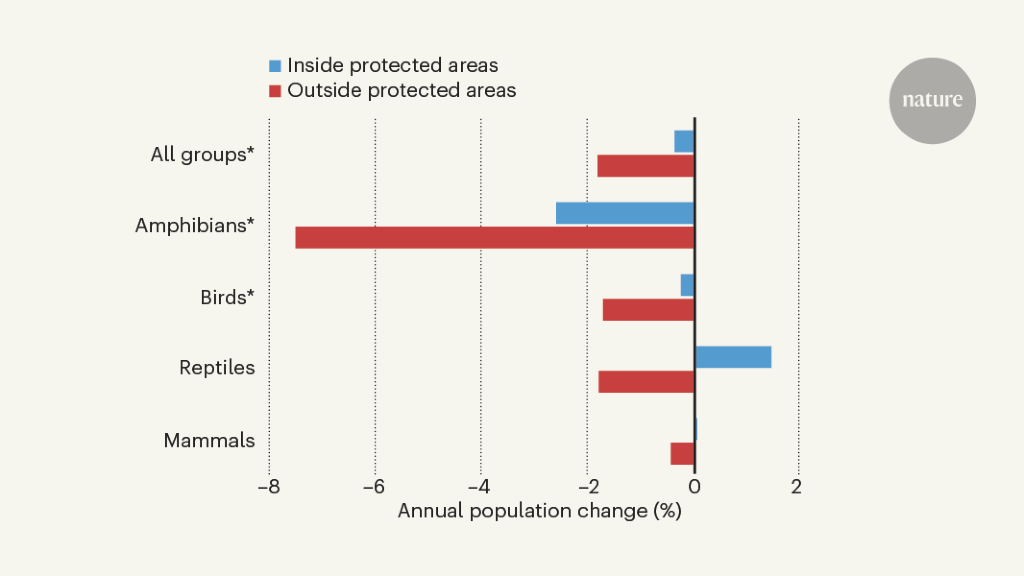
Measuring the ecological benefits of protected areas

Nature – Global-scale assessment of the effectiveness of a key conservation tool.

Source: Measuring the ecological benefits of protected areas

This is an important article! In the image above, the lines to the left are bad. The longer to the left the worse it is. The blue lines are symbolic of our National Parks. The blue lines do not extend as far to the left and show less degradation of biodiversity. It is important that even in protected areas most blue lines are to the left and show a reduction in biodiversity.

Our national parks are one of the last bastions of biological diversity. And yet the Park officials are drastically increasing their pesticide use. One of the main issues with our current over use of pesticides _in_ our national parks is the National Park Service NPS’s claim that the parks have to “battle” all the invasive species.

And yet the reality is exactly the opposite of that!

The national parks are the best area to allow their relatively large native biodiversity time! Time for our native biology to evolve and control the invasive species. Even time for the invasive species to evolve and coexist with the native natural environment. Our national parks are losing biodiversity everyday to pesticide use. The more biodiversity there is the more opportunity the native biology has to evolve and control the invasive species.

The Pesticide industrial Complex is manipulating the idea of invasive species in order to increase their profit from toxic chemicals. It is almost a certainty that the pesticides are worse than even the invasive species. I have pointed out many, many times that roundup was originally described as an antibiotic and yet the first thing the “Save This Or That Area group does is spray the whole thing with Roundup to “kill off the _invasive species_.” This destruction of the soil food web and wetland microbial habitat is virtually guaranteed to prevent any true restoration. And then holy smokes in 10 or 20 years it’s magically all a mess and just _has_ to be drained, leveled, and built on. I have started a permaculture sustainability project to identify, quantify, and analyze pesticide use in our national parks if you would like to be part of this project please contact me.
The best to you all.

Spread the Good News Below: Permaculture!
Posted in Uncategorized | Comments Off on Measuring the ecological benefits of protected areas

Oppose Mosquito Spraying In Santa Clara County – SAVE THE FROGS!

SAVE THE FROGS! opposes the spraying of pesticides to combat mosquitoes in Santa Clara County, California as the project harms humans and wildlife.

Source: Oppose Mosquito Spraying In Santa Clara County – SAVE THE FROGS!

Save the frogs is an awesome group and I would encourage all of my readers to visit and at least purchase a t-shirt from them!
https://savethefrogs.com/

Spread the Good News Below: Permaculture!
Posted in Uncategorized | Leave a comment

‘Zombie’ deer disease confirmed at Yellowstone โ€” officials warn to…

The geysers aren’t the only thing foaming at the mouth.

Source: ‘Zombie’ deer disease confirmed at Yellowstone โ€” officials warn to…

This is so sad. This is mad cow disease transferred to deer because the Midwest was feeding cattle feed to increase the deer population for better hunting in the spring. It is also in elk but I don’t know whether the elk cases have crossed the Rockies yet.

The worrisome thing is that there is a British study suggesting that dogs can get this disease from canned dog food. http://siriusdog.com/dog-food-mad-cow/amp/

There’s a huge amount of politics involved in this because it is the US meat producers that caused 90% of the problem. The US was using sick cows, cows that were too sick to stand and be butchered, as ground up protein supplement for … You guessed it – cows. This is the primary way that the mad cow prion disease was spread. Feeding ground up cows to cows. And the US was also using it a lot in pet food. So it’s your choice whether to believe the European study, or all the American studies that assure us that there is no link to pets. But realize if the European studies are correct this could mean that our newly established and beneficial wolf population is in serious danger.
Best to you all!!!
Bob

Spread the Good News Below: Permaculture!
Posted in Uncategorized | Comments Off on ‘Zombie’ deer disease confirmed at Yellowstone โ€” officials warn to…

Brief Summary National Parks pesticide use.

Brief Summary, timeline so far.

I have recently discovered that our national parks are using significantly more pesticides than I had assumed and I am deeply concerned about this impact on our native creatures. The use of pesticides in our national parks could have impacts on endangered animals across the board; frogs, newts, their eggs and young, bats (have you thought about bat mother's milk?), and many, many others -- sticklebacks, birds? Many biocides have an impact on animals far more than just the adults.

In my opinion it is _critical_ that this important data is made much more available to researchers and concerned citizens who are knowledgeable about specific pesticide properties, endangered species, or habitat challenges. I am not convinced that the wonderful, hard-working people in the Parks Service can always be fully up on current research on the latest greatest neurotoxin or DNA regulatory system poison, and the impact these poisons will have on our endangered wildlife. Getting specific chemical names, the amounts used, and locations is vital for any intelligent analysis of pesticide use.

I initially assumed that pesticide use was a fairly reasonable amount - a couple of pounds here and there. I mean, after all they are protecting our natural lands right?.
But the longer time has gone on and the vigorous resistance I have received to acquiring any information at _all_, the more concerned I have become. Our National Parks should not be Monsanto's, DuPont's, and Dow chemical's testing grounds or personal playpens.

This is a summary as of November 20th. Much more detailed information than you would probably like is at..... www.puravidaaquatic.com/wordpress/summary-our-national-toxic-parks-project-as-of-november-15th/ And even worse; mind numbingly more details at.... www.puravidaaquatic.com/wordpress/our-national-toxic-parks/

_____________________________________________ Current attempts at contacting Park officials and getting pesticide data....

Phone, Email, or web links contacted. Not in chronological order.

Main Freedom Of Information Act site, www.foia.gov/ , Thursday Oct 19th 2023 freedom of information act FOIA filed, No response yet

Everglades, Hillary Cooley 305-242-7875 Hillary_cooley@nps.gov , October 18th,sent voice message., No response
November 20th sent email., Often voice message calls can be dropped...
November 21st, responded, sorry not going to give it to you _contact FOIA.
November 22nd,sent,sorry you misunderstood. I want _your_ public documents _And budget.

Hillary had cc'd public relations gal. November 22nd, sent email and I asked her for her background.

Sequoia National Park, general information 559-565-3341,October 18th,sent voice message., no response yet.
November 20th, https://www.nps.gov/seki/contacts.htm, sent, form , no response yet.

NPS Commercial Services Environmental Audits,
cs_envaudits@nps.gov,November 6th 2023,sent,, Not responsible for this information. Actually they mistold the truth. They are directly associated with integrated Pest Management.

Yosemite National Park,
yose_superintendent@nps.gov, Thursday Oct 19th 2023,contact form on Yosemite's website sent. Responded 10/31 with link that doesn't work and junk.
sent asking for the integrated Pest Management officer or office contact link no response yet.
Thursday November 14th,sent the link you supplied does not work., November 14th replied no PUPS link and complete change of original email., junk
November 20th, sent, reiterated request for PUPS access and their public documents., no response yet.

Take home point so far: junk and no responses.

State of California Pesticide Usage Reporting (PUR),
PUR.lnquiry@cdpr.ca.gov, Monday November 6th 2023,sent, CDPRWeb@cdpr.ca.gov, Monday November 6th 2023,sent, November 13th, received, very nice response_ but National Parks are not required to, and do not give them any data.

Regional IPM Coordinator Pacific West Region Brent Johnson, e-mail us... www.nps.gov/orgs/1103/ipm.htm ,Wednesday November 8th,sent,
November 17th reply, nope_ not going to give you any information. contact FOIA.
November 20th, reply, no thank _you_ Brent I want all public documents that you have filed with local counties and I want your budget.

Sierra club main office,
communications@dc.sierraclub.org,sent, any interest in publishing an annual report?, No response yet.

World wildlife fund (WWF), November 19th,https://help.worldwildlife.org/hc/en-us/requests/new, partial response November 20th.

Audubon society, November 19th,media@audubon.org no response yet.

The Nature Conservancy, November 20th,editor@tnc.org no response yet

Continued Googling starts turning up reports of problems in the Parks
https://peer.org/park-service-lack-of-transparency-created-its-huge-foia-backlog/
.
Close to 1,500 National Park Service FOIA request backlog. Certainly seems that they're just ignoring many of them.

And how about ....
http://www.schundler.net/TheDarkSide.htm

Things like this maybe why there are all those FOIA backlogs. (1500 ๐Ÿ˜ฎ)That and the fact that it is specifically written into the FOIA law that there are _no_ penalties for ignoring them. ๐Ÿ˜†. So I emailed the guy above and he sent me a very nice response back. Which is why this is included in the summary. Hmmm budgets if anyone wants to get curious.

_____________________________________________
Googling world wide Web for "Integrated Pest Management" "National parks (NPS IPM)",mid-october, NPS integrated Pest Management IPM required by federal law., YES! Hmmmmmmm Why didn't Yosemite superintendent mention this? And why when I asked specifically for it did she ignore it.

_____________________________________________
Attempt to search the National Park service PUPS database link that the Superintendent of Yosemite sent me in response to my question about pesticide use in Yosemite National park. irma.nps.gov/Portal, Link gives Error message....small link at the bottom to irma.nps.gov/DataStore/Search/Quick,This error message link is _not_ PUPS. It is to a large database on Park publications, some going back to 1914. Searched this database for "PUPS pesticide" in all national parks 4 integrated Pest Management articles oops :-) but they don't really say anything other than that they're using pesticides according to Monsanto and Dow chemical and Dupont's PR departments. Now think about four results in a database that contains tens of thousands of records and includes dates from 1914; where the Integrated Pest Management offices are _supposed" to be doing monthly reports to counties, and annual reports federally. And there are only four (accidental?) entries. Oh my.

Searched for "Pesticide applied" in _all_ national parks., 34 results, Most were meaningless for our purposes. There were some published "effectiveness of ...." reports that were obviously funded by pesticide manufacturing companies. But there were two "pesticide use log(s)" one for Pea Ridge National Military Park. 1991. Pesticide Use Log. Pea Ridge, AR and the other Pea Ridge National Military Park. 1994. Pesticide Use Logs. Pea Ridge, AR.... WOW but I had trouble getting anything other than a summary. In both cases looking under "Permissions" led to the description "Permission to Download Files": "NPS Staff" other links are "public" . The reports are supposed to be public, and are on a public database, but the permission to download any usable files are restricted to NPS staff. How awesome for our public records in our National Parks.
The following searches were done on the IRMA database for Yosemite specifically. "pesticide", "pesticide application", "application pesticide", "glyphosate", "Roundup", "Round_up", "Round-up", "Rodeo, "Biocide, "IPM coordinator", "Integrated Pest Management", "integrated pest Managements", "Federal Pesticide Management", "insecticides" Nothing on _applying_ pesticides

Take home point: Most governmental agencies have not bothered to contact me back. Yosemite the only Park to contact me back has simply given me the runaround. Links that don't work, information that is not valid, and then a complete change in what they told me at first. The massive IRMA Park database which has tens of thousands of publications and supposedly includes all "science" being done in the parks includes only four references to the PUPS database, none of which have any data that the public can download. Neither does it have a single word about pesticide _application_ in most of our national parks, again they seem to be only worried about blaming pesticide drift from outside the park. Not what they've been applying since almost certainly the '50s. And lastly when Yosemite Park specifically is searched on IRMA there is no public record of _any_ publication dealing with pesticide application, the Integrated Pest Management office, or Federal Pesticide Management.

You decide whether this is unusual or not. I have decided that this is going to be the start of a permaculture sustainability project to obtain access to the National Park Service (NPS) Integrated Pest Management (IPM) Database. If you would like to be a part of this project please contact us.

www.puravidaaquatic.com/ www.puravidaaquatics.com/ 310-429-8477

Spread the Good News Below: Permaculture!
Posted in Uncategorized | Leave a comment