My Favorite Posts

Main Website at: www.PuraVidaAquatic.com

@vidaaquatic on X

Posts that I particularly like.

And a great way to find posts that you like is to use the search on any of the pages.

And if you would like to leave a comment but worry about your email address, I do not require it. Just fill in your name and leave the email blank.

Best to you all.

PS. Please don’t try to digest this all in one sitting :-). You’ll probably get food poisoning! :-)

neem-oil/

my-pond/

water-bowls/

gophers/

old-growth-wetlands/

genes-for-blue-eyes/

genetics and DNA/

kinder-gentler-world-of-sexes/

bushtits/

maybe-i-am-not-a-permaculturist/

tanglefoot-stuff/

waaaaaaaaaaahaaaaaaa/

do-_not_-like-this/

thoughts-religion-permaculture-kindness/

lawsuit-accusing-monsanto-of-false-advertising/

mumps-outbreaks-linked-to-waning-vaccine-protection/

3-reasons-no-4-reasons-why-were-fatter-than-30-years-ago/

Past OurToxicNationalParks posts

Best to you all

Bob

Main Website at: www.PuraVidaAquatic.com

Spread the Good News Below: Permaculture!
Posted in Uncategorized | Leave a comment

OTNP MAR 2026

OTNP December 2025
Good morning lovely people.
I am going to repost this really good Mr. Sandman parody by two very talented young women. They are one of the reasons why I spend so much time on this project. There are people that have talents other than what I have and yet don’t have talents in database construction, the interface between chemistry and biology, and some of the other gifts I have.

If you didn’t listen to it last time certainly consider giving it a try! And if you did listen to it listen to it again like I have!

Nice guitar work!
https://www.facebook.com/reel/25313109035019259/?mibextid=9drbnH&s=yWDuG2&fs=e


I am deeply concerned about the child abuse our pesticide industry is perpetrating.
We must have a zero tolerance policy for neurotoxic pesticides around our children.
Zero tolerance for at least one mile around public and private schools. We must have zero tolerance of neurotoxins around places of worship; churches, mosques, synagogues, etc. We must have absolutely zero tolerance for neurotoxic child abuse around municipal parks.
California dpr is not only racist (as claimed by Californians for Pesticide Reform) but they are in effect also child abusers.
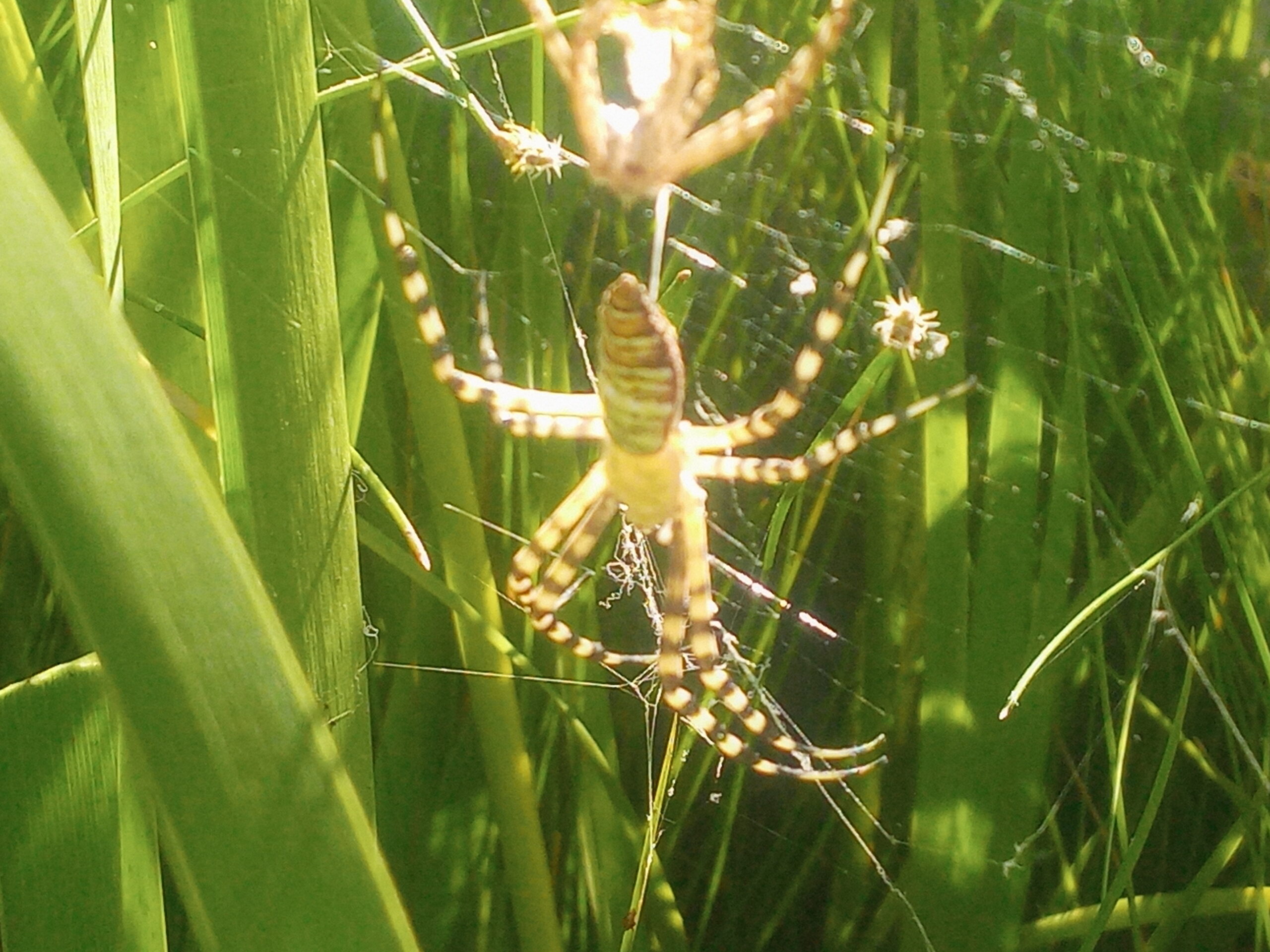
I had a voice meeting recently with representatives from the California department of pesticide regulation (cdpr) and I was able to ask several questions. One was primarily about the makeup of the teams that regulate pesticides. These “teams” are given names such as oak, redwood, maple, cedar and pine and are central to the agency’s work, yet there is very little public information regarding who decides their makeup or how specific, active ingredients are assigned to them.

Pesticides are incredibly diverse. They range from biological life forms to complex chemical toxins like neonicotinoids and “forever chemicals.” Currently, there is no clear published rationale by the cdpr for how these materials are assigned to various teams.

The cdpr actually argues that this is a “feature”, as a generalist approach ensures knowledge overlap if a member leaves. I believe this lacks the effectiveness of true specialization. A system that allows specialists to focus on specific chemical or biological properties would be far _more_ robust and less susceptible to the gaps created when team members depart. Without clear rules, the current system remains vulnerable to political and financial influence.
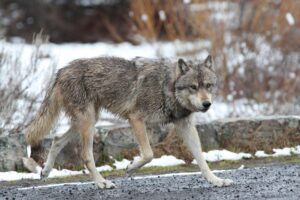
While none of the teams at the heart of the cdpr regulation of pesticides have clear boundaries, The pesticides they are responsible for do have clear boundaries. The active ingredients can be classified as bacterial life forms, viral life forms, and other materials in addition to all the chemical toxins. The toxic chemicals also fall into various categories herbicides, insecticides, avicides as well as being in different classes of chemical compounds such as neonicotinoids, synthetic pyrethrins, and especially important, how long any of these toxins persist in the environment. This last physical property (the half life) has become vitally important with the identification of more and more so-called forever chemicals. We desperately need to have a team made up of members who are focused and particularly knowledgeable on these.

No rhyme or reason to how the chemicals are being assigned to various teams and the cdpr website and the representatives I talked to claim that this is somehow more robust. This is nothing but gobbledygook. How is a system that has teams specializing on specific groups of compounds somehow _less_ robust?

A system that allows the team members to work with other team members having similar knowledge and focus enhances the knowledge about the specific chemical properties or biologics that they’re working with. Teams without any specialization cannot possibly have the independent ability to understand and critically determine all the ramifications of the random hodgepodge of chemicals and biologicals they are assigned. The teams must be able to focus and specialize on these incredibly complex chemical and biologic systems. And the rules for assigning chemicals must be clear and stated in new online cdpr documents.

If one member of a specialized team leaves there is still plenty of knowledge remaining. In fact this would be far _more_ robust than scattering knowledge to the winds.

Where as if an unspecialized team has been assigned a group of biological organisms and their one person with a somewhat better biological knowledge leaves, there is no one to fill the gap. And the cdpr claims that they do not regularly reassign active ingredients to other teams in the event of a team member leaving.

The current system is simply too susceptible to team member loss, abuse, politics, money, and mushroom growth (think lighting and food).

In my opinion this is not pesticide _regulation_ it is a freeway on ramp, and it is killing our kids.

On a completely new topic I received a newsletter from chaparral wisdom recently that I thought I would put here with some information and links. Given my rant just above I truly loved the quote “Using Orwellian double-speak to mask the madness” 😆🫤🤔🥴😮😳

Chaparral Wisdom Read on blog or Reader
The End of Wild Nature in California
CA Chaparral Institute Avatar
By CA Chaparral Institute on March 4, 2026

Governor Newsom and Cal Fire target all wildlands in California
with herbicides, logging, grinding machines, and fire

Part I: The scope of the destruction

One third of California, 35.5 million acres, are in the sights of the state’s new, updated Vegetation Management Program (VTP). Rather than something to cherish, Nature is now seen as the enemy, a thing that needs to be controlled, mitigated, cleared. Using Orwellian double-speak to mask the madness, the clearance and ripping apart dense, biodiverse habitat is referred to as “ecological restoration,” improving “forest health,” and making wildlands “fire resilient.”

In this eleven part series we will be offering an in-depth look into the consequences of the belief that Nature can not function without us, and needs to be forever mowed, trimmed, and chemically treated
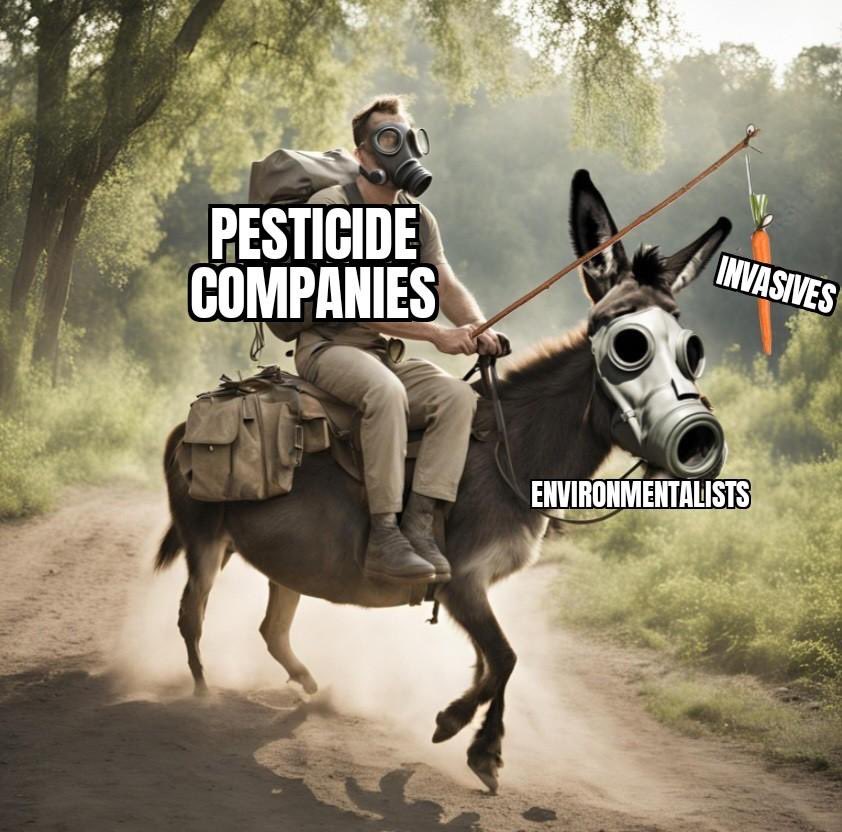
The series of posts above by the chaparral institute has additional implications about the past spraying of carbaryl in our oak forests _in order to protect them_.

Spraying promoted by industry, and salespeople as well as the Sierra Club itself. This has led to serious consequences to all the animals that actually call our oak forests home. You know, all the animals that can’t go to their nest in the oak branches and take a hot shower to wash the toxins off their paws and (furry, webbed, bird, etc.) feet. Wonder how many people that were involved in that spraying program (including the Sierra Club members) would like to have that amount of carbaryl dusted around their own living rooms. It would not quite be the same as they wouldn’t have to lick it off their hands and feet.

Beware “integrated pest management” stories. IPM is simply the NRA of the pesticide industry.

IPM advocates _responsible_ pesticide use. …. More, and more, and more of it … very subtly very deliberately.

We desperately need
#ChemFreeZones
Especially around our schools!

Please ask our environmental organizations to provide basic information on what pesticides the national parks are spraying.
https://chng.it/9Dj4vKwbK5
https://www.puravidaaquatic.com/wordpress/just-three-easy-steps/

For past OTNP (#_OTNP on X) issues.
https://www.puravidaaquatic.com/wordpress/past-ourtoxicnationalparks-posts/
But you may want to start here. www.puravidaaquatic.com/wordpress/why-i-started-this/
If you have received this as a forward and would like to continue receiving it please email me “vidaaquatic@gmail.com”
And if you would like to donate as little as $5 to the cause, you can Zelle it to vidaaquatic@gmail.com. thank you very much. Bob
Spread the Good News Below: Permaculture!

Posted in Uncategorized | Leave a comment

California almonds

Chemical Weights Table


Chemical Weights Table

Chemical Weight (lbs) Weight (tons)
(e)-5-decenyl acetate 0.01 0.0
(e,e)-8,10-dodecadien-1-ol 11.13 0.0
(z,z)-11,13-hexadecadienal 1852.17 0.9
1,3-dichloropropene 925202.87 462.6
2,4-d 1739.44 0.9
2,4-d, diethanolamine salt 1385.57 0.7
2,4-d, dimethylamine salt 73713.96 36.9
2,4-dichlorophenoxyacetic acid, choline salt 6281.78 3.1
2-(3-hydroxypropyl)-hepta-methyl trisiloxane, ethoxylated, acetate 18925.68 9.5
2-butoxyethanol 461.35 0.2
3,7-dimethyl-6-octen-1-ol 9.96 0.0
4-nonylphenol, formaldehyde resin, propoxylated 44516.6 22.3
Abamectin 16488.6 8.2
Acephate 2263.41 1.1
Acequinocyl 141.7 0.1
Acetamiprid 2569.89 1.3
Acrylic acid-butyl acrylate-styrene copolymer 37623.29 18.8
Aggregated adjuvant data 107809.09 53.9
Agrobacterium radiobacter strain: k84 8.25 0.0
Albifimbia verrucariasolids and solubles strain: aarc-0255 183.61 0.1
Alcohols, c12-14-secondary, ethoxylated 76197.86 38.1
Alkyl (c8,c10) polyglucoside 17293.55 8.6
Allethrin 0.24 0.0
Allyl polyoxyethylene acetate 21.42 0.0
Alpha-(para-dodecylphenyl)-omega-hydroxypoly(oxyethylene) 857.33 0.4
Alpha-(para-nonylphenyl)-omega-hydroxypoly (oxyethylene) sulfate, ammonium salt 2.83 0.0
Alpha-(para-nonylphenyl)-omega-hydroxypoly(oxyethylene) 562754.89 281.4
Alpha-(para-nonylphenyl)-omega-hydroxypoly(oxyethylene) 30.23 0.0
Alpha-(para-nonylphenyl)-omega-hydroxypoly(oxyethylene), branched 13340.59 6.7
Alpha-(para-nonylphenyl)-omega-hydroxypoly(oxyethylene), phosphate ester 30625.71 15.3
Alpha-(para-tert-butylphenyl)-omega-hydroxypoly(oxyethylene) phosphate 1841.95 0.9
Alpha-2,6,8-trimethyl-4-nonyloxy-omega-hydroxypoly(oxyethylene) 7070.94 3.5
Alpha-alkyl (c10-c16)-omega-hydroxypoly(oxyethylene) 9281.61 4.6
Alpha-alkyl (c10-c16)-omega-hydroxypoly(oxyethylene) 30.23 0.0
Alpha-alkyl (c12-c14)-omega-hydroxypoly(oxyethylene) 17190.4 8.6
Alpha-alkyl (c9-c11)-omega-hydroxypoly(oxyethylene) 46481.45 23.2
Alpha-alkylaryl-omega-hydroxypoly(oxyethylene) 1.19 0.0
Alpha-cypermethrin 75.43 0.0
Alpha-isodecyl-omega-hydroxypoly(oxyethylene) 719.52 0.4
Alpha-pinene-beta-pinene copolymer 46038.37 23.0
Alpha-tridecyl-omega-hydroxypoly(oxyethanol) phosphate 20751.44 10.4
Alpha-undecyl-omega-hydroxypoly(oxyethylene) 162896.81 81.4
Alpha-[para-(1,1,3,3-tetramethylbutyl)phenyl]-omega-hydroxypoly(oxyethylene) 67.96 0.0
Aluminum phosphide 1170.27 0.6
Aluminum phosphide 1463.54 0.7
Aluminum phosphide 1211.98 0.6
Aluminum phosphide 11.25 0.0
Aluminum phosphide 281.07 0.1
Aluminum phosphide 8422.46 4.2
Aluminum phosphide 443.86 0.2
Amines, tallow alkyl, ethoxylated propoxylated 76.45 0.0
Aminoethoxyvinylglycine hydrochloride 311.49 0.2
Ammonium nitrate 10288.18 5.1
Ammonium propionate 15400.45 7.7
Ammonium sulfate 314090.93 157.0
Aspergillus flavus strain: af-36 1.55 0.0
Aureobasidium pullulans subspecies pullulans dsm # 14940 Almond 236.31 0.1
Aureobasidium pullulans subspecies pullulans dsm # 14941 Almond 236.31 0.1
Azadirachtin 190.83 0.1
Azoxystrobin 140746.31 70.4
Bacillus altitudinis strain: qst 2808 218.54 0.1
Bacillus amyloliquefacens strain: f727 10582.54 5.3
Bacillus subtilis subspecies subtilis strain: iab/bs03 0.97 0.0
Bacillus thuringiensis (berliner), subsp. kurstaki, strain sa-11 8910.67 4.5
Bacillus thuringiensis subsp. aizawai strain: abts-1857 3866.24 1.9
Bacillus thuringiensis subsp. aizawai strain: gc-91 2.5 0.0
Bacillus thuringiensis subsp. kurstaki strain: abts-351 25825.94 12.9
Bacillus thuringiensis subsp. kurstaki strain: evb-113-19 26327.53 13.2
Bacillus thuringiensis subsp. kurstaki strain: sa-12 144.5 0.1
Bacillus velensis strain: qst 713 1936.02 1.0
Bacillus velezensis strain: d747 10967.11 5.5
Bacillus velezensis strain: mbi 600 697.84 0.3
Beauveria bassiana strain: gha 164.45 0.1
Benzoic acid 367.4 0.2
Beta-conglutin 1350.91 0.7
Beta-cyfluthrin 367.58 0.2
Bifenazate 107865.6 53.9
Bifenthrin 104939.77 52.5
Boscalid 17233.94 8.6
Buprofezin 7629.31 3.8
Burkholderia rinojensis strain a396 146202.65 73.1
Butadiene-styrene copolymer 260 0.1
Butyl lactate 68.93 0.0
Calcium chloride 3818.11 1.9
Calcium hypochlorite 2.03 0.0
Canola oil 34.09 0.0
Capric acid 52759.9 26.4
Caprylic acid 68279.99 34.1
Capsicum oleoresin 1.17 0.0
Captan 2699.59 1.3
Captan, other related 24.52 0.0
Carbaryl 2.5 0.0
Carbon 59.2 0.0
Carbon dioxide 7371.62 3.7
Carbon dioxide 4495.5 2.2
Carfentrazone-ethyl 1132.62 0.6
Castor oil ethoxylate 10402.6 5.2
Cerevisane (cell walls of saccharomyces cerevisiae strain las117) 457.06 0.2
Chlorantraniliprole 79864.21 39.9
Chlorophacinone 0.11 0.0
Chloropicrin 292268.58 146.1
Chlorothalonil 383199.51 191.6
Chlorpyrifos 0.02 0.0
Chromobacterium subtsugae strain: praa4-1 2602.7 1.3
Citric acid 73798.78 36.9
Clarified hydrophobic extract of neem oil 244.55 0.1
Clethodim 65755.72 32.9
Clofentezine 12437.54 6.2
Clothianidin 565.49 0.3
Coconut diethanolamide 9474.27 4.7
Copper hydroxide 232510.94 116.3
Copper octanoate 800.2 0.4
Copper oxychloride 18144.47 9.1
Copper sulfate (basic) 37692.26 18.8
Copper sulfate (pentahydrate) 12773.87 6.4
Cuprous oxide 42249.38 21.1
Cyantraniliprole 3028.22 1.5
Cyclaniliprole 4.09 0.0
Cyflumetofen 36387.26 18.2
Cyfluthrin 285 0.1
Cyprodinil 57762.94 28.9
D-glucopyranose, oligomeric, c9-11-alkyl glycosides 263.22 0.1
Ddvp 1.8 0.0
Ddvp 1.7 0.0
Deltamethrin 0.16 0.0
Diatomaceous earth 8184.14 4.1
Dichlorprop butoxyethanol ester 0.99 0.0
Didecyl dimethyl ammonium chloride 0.45 0.0
Diethylene glycol 48818.56 24.4
Difenoconazole 70036.53 35.0
Diflubenzuron 2510.93 1.3
Dimethyl alkyl tertiary amines 401 0.2
Dimethylpolysiloxane 41931.83 21.0
Dinocap 1.88 0.0
Dioctyl dimethyl ammonium chloride 0.3 0.0
Diphacinone 1.19 0.0
Diphacinone 0.02 0.0
Diquat dibromide 658.51 0.3
Dodecylbenzene sulfonic acid 57.97 0.0
E-8-dodecenyl acetate 0.43 0.0
Edta, tetrasodium salt 3.57 0.0
Emamectin benzoate 145.52 0.1
Emulsifiable methylated vegetable oil 64759.11 32.4
Eptc 1807.81 0.9
Esfenvalerate 8649.32 4.3
Ethanolamine 1469.17 0.7
Ethylene glycol 13793.16 6.9
Etoxazole 45100.71 22.6
Farnesol 3.99 0.0
Fatty acids, c16-18 and c18-unsaturated, branched and linear 443.34 0.2
Fatty acids, c16-c18 and c18-unsaturated, methyl esters 135185.17 67.6
Fatty acids, methyl esters 106950.05 53.5
Fatty acids, mixed 1953.8 1.0
Fatty acids, tallow 6876.56 3.4
Fenazaquin 29653.71 14.8
Fenbuconazole 2696.62 1.3
Fenbutatin-oxide 1016.43 0.5
Fenhexamid 648.7 0.3
Fenpropathrin 2590.8 1.3
Fenpyroximate 7103.86 3.6
Ferric sodium edta 227.8 0.1
Flazasulfuron 55.45 0.0
Flonicamid 38.52 0.0
Fluazifop-p-butyl 432.54 0.2
Fludioxonil 0.2 0.0
Flumioxazin 32352.42 16.2
Fluopyram 17741 8.9
Flupyradifurone 3.39 0.0
Flutriafol 2482.73 1.2
Fluxapyroxad 30381.78 15.2
Forchlorfenuron 45.44 0.0
Fosetyl-al 60 0.0
Garlic 37.84 0.0
Geraniol 9.96 0.0
Glufosinate-ammonium 760842.29 380.4
Glycerol 42157.77 21.1
Glyphosate, diammonium salt 9936.1 5.0
Glyphosate, isopropylamine salt 1364971.9 682.5
Glyphosate, potassium salt 1667115.24 833.6
Gs-omega/kappa-hxtx-hv1a, versitude peptide 4007.12 2.0
Halosulfuron-methyl 0.75 0.0
Harpin protein 0.04 0.0
Heptamethyltrisiloxane ethoxylated 19720.34 9.9
Heptamethyltrisiloxane-1,3-propanediol ether, ethoxylated propoxylated 20317.67 10.2
Hexythiazox 21655.8 10.8
Hydramethylnon 0.33 0.0
Hydrogen cyanamide 1612.32 0.8
Hydrogen peroxide 32098.44 16.0
Imidacloprid 18.13 0.0
Indaziflam 8565.42 4.3
Indoxacarb 1041.46 0.5
Iprodione 3291.53 1.6
Iron hedta 5769.74 2.9
Iron phosphate 13.15 0.0
Isodecanol, ethoxylated, phosphate ester 1697.62 0.8
Isofetamid 8640.86 4.3
Isopropyl alcohol 11683.13 5.8
Isopropylamine dodecylbenzene sulfonate 585.69 0.3
Isoxaben 1617.53 0.8
Kaolin 855 0.4
Kasugamycin hydrochloride 787.1 0.4
Lambda-cyhalothrin 24288.02 12.1
Lauric acid 1895.22 0.9
Lecithin 256642.4 128.3
Lime-sulfur 60371.53 30.2
Limonene 9227.83 4.6
Low molecular weight paraffinic oil 11780.73 5.9
Magnesium phosphide 1180.46 0.6
Magnesium phosphide 431.24 0.2
Magnesium phosphide 14.67 0.0
Magnesium phosphide 2119.39 1.1
Mancozeb 54694.38 27.3
Mandipropamid 8.77 0.0
Margosa oil 1678.28 0.8
Mefenoxam 11929.48 6.0
Mefentrifluconazole 22424.3 11.2
Mesotrione 7562.62 3.8
Metaflumizone 305.78 0.2
Metaldehyde 3.2 0.0
Metconazole 25530.15 12.8
Methoxychlor 45.37 0.0
Methoxychlor, other related 6.19 0.0
Methoxyfenozide 339785.56 169.9
Methyl bromide 2429 1.2
Methyl bromide 28829.95 14.4
Methyl bromide 2114.02 1.1
Methyl bromide 153 0.1
Methyl bromide 2076 1.0
Methyl bromide 360 0.2
Methyl silicone resins 29405.95 14.7
Methylated fatty acids from canola oil 81696.7 40.8
Methylated silicones 41586.51 20.8
Methylated soybean oil 844691.52 422.3
Mineral oil 8573114.1 4286.6
Modified phthalic glycerol alkyd resin 4920.68 2.5
Myclobutanil 197.41 0.1
N,n-bis-(2-omega-hydroxypoly(oxyethylene)ethyl)alkylamine, alkyl derived from tallow fatty acids 65150.18 32.6
N-octyl bicycloheptene dicarboximide 0.81 0.0
Naled 2.1 0.0
Napropamide 72.11 0.0
Nerolidol 9.96 0.0
Norflurazon 275.94 0.1
Octyl decyl dimethyl ammonium chloride 0.75 0.0
Oleic acid 28840.9 14.4
Oleic acid, ethyl ester 52341.57 26.2
Oleic acid, methyl ester 266159.31 133.1
Orthosulfamuron 7580.75 3.8
Oryzalin 1706.73 0.9
Oxathiapiprolin 4564.91 2.3
Oxyfluorfen 310498.05 155.2
Paraquat dichloride 96732.7 48.4
Parathion 67.59 0.0
Parathion, other related 2.13 0.0
Pendimethalin 674952.98 337.5
Penoxsulam 899.34 0.4
Penthiopyrad 50450.35 25.2
Permethrin 3543.96 1.8
Peroxyacetic acid 5902.44 3.0
Petroleum distillates 99.89 0.0
Phosmet 3148.65 1.6
Phosphine 1057.11 0.5
Phosphine 0.32 0.0
Phosphine 24.35 0.0
Phosphine 65.47 0.0
Phosphine 2421.45 1.2
Phosphine 12.8 0.0
Phosphoric acid 34632.72 17.3
Picoxystrobin 174.39 0.1
Piperonyl butoxide 153.55 0.1
Piperonyl butoxide, other related 0.1 0.0
Poly(oxy-1,2-ethanediyl), alpha-hydro-omega-hydroxy-, mono-c11-14-isoalkyl ethers, c13-rich, phosphates 19.25 0.0
Poly(oxyethylene) poly(oxypropylene) glycol monoallyl ether 5857.77 2.9
Polyacrylamide 1927.35 1.0
Polyacrylamide, polyethylene glycol mixture 46.98 0.0
Polyalkeneoxide modified heptamethyltrisiloxane 11078.96 5.5
Polybutene 27833.96 13.9
Polyethylene glycol 59268.58 29.6
Polyethylene glycol diacetate 1.95 0.0
Polyethylene glycol mono-c10-16-alkyl ether sulfate sodium salt 5990 3.0
Polyethylene glycol stearate 13085.39 6.5
Polymerized pinene 5062.21 2.5
Polyoxin d, zinc salt 5833.22 2.9
Polyoxyethylene polyol fatty acid esters 573.31 0.3
Polyoxyethylene polyoxypropylene 12408.73 6.2
Polyoxyethylene sorbitan mixed fatty acid esters 586.86 0.3
Polyoxyethylene sorbitan monolaurate 571.45 0.3
Polyoxyethylene sorbitan monooleate 2274.35 1.1
Polyoxyethylene sorbitan trioleate 3300.21 1.7
Polyoxyethylene sorbitol, mixed ether ester 7606.12 3.8
Polypropylene glycol 1.61 0.0
Potassium hydroxide 1700.91 0.9
Potassium laurate 24.15 0.0
Potassium nitrate 9189.81 4.6
Potassium phosphite 396601.27 198.3
Potassium silicate 429.8 0.2
Propargite 12033.6 6.0
Propiconazole 45059.88 22.5
Propionic acid 53112.12 26.6
Propylene glycol 20091.39 10.0
Propylene oxide 540 0.3
Propylene oxide 1944 1.0
Propylene oxide 21572 10.8
Pseudomonas chlororaphis subsp. aurantiaca strain: afs009 1317.78 0.7
Purpureocillium lilacinum strain 251 30.36 0.0
Pydiflumetofen 10850.48 5.4
Pyraclostrobin 39135.53 19.6
Pyraflufen-ethyl 595.71 0.3
Pyrethrins 586.8 0.3
Pyridaben 9.38 0.0
Pyrimethanil 28533.1 14.3
Pyriproxyfen 2456.64 1.2
Reynoutria sachalinensis (giant knotweed) plant extract 3640.57 1.8
Rimsulfuron 14955 7.5
S-methoprene 270.39 0.1
S-methoprene 0.31 0.0
Saflufenacil 18562.97 9.3
Sethoxydim 9190.63 4.6
Silica filled polydimethylsiloxane 1.37 0.0
Silicone -0 glycol copolymer 1560.54 0.8
Silicone defoamer 15.86 0.0
Simazine 6992.24 3.5
Sodium diisooctylsulfosuccinate 276.52 0.1
Sodium hydroxide 5876.73 2.9
Sodium nitrate 112.06 0.1
Sodium tripolyphosphate 1510.21 0.8
Sodium xylene sulfonate 3700.01 1.9
Sorbitan fatty acid esters 19.78 0.0
Sorbitan monooleate 396.2 0.2
Sorbitol 2641.42 1.3
Soybean oil 4322.71 2.2
Soybean oil, ethoxylated 20379.69 10.2
Spinetoram 11333.11 5.7
Spinosad 1012.6 0.5
Spirodiclofen 12660.84 6.3
Spiromesifen 0.36 0.0
Spirotetramat 644.04 0.3
Strepomyces lydicus strain: wyec 108 0.35 0.0
Strychnine 112.69 0.1
Sulfoxaflor 1.62 0.0
Sulfur 840663.61 420.3
Sulfuric acid 1779.59 0.9
Sulfuryl fluoride 109327.41 54.7
Sulfuryl fluoride 70685.77 35.3
Sulfuryl fluoride 23498.91 11.7
Sulfuryl fluoride 90.82 0.0
Sulfuryl fluoride 22249.71 11.1
Swinglea glutinosa extract 1878.13 0.9
Tall oil 6126.54 3.1
Tall oil fatty acids 94457.3 47.2
Tebuconazole 29642.13 14.8
Tebufenozide 4.13 0.0
Tetrapotassium pyrophosphate 8.92 0.0
Thiophanate-methyl 108543.75 54.3
Triethanolamine 4793.38 2.4
Triethanolamine oleate 88.12 0.0
Trifloxystrobin 19398.07 9.7
Trifluralin 11196.61 5.6
Urea 4919.25 2.5
Urea dihydrogen sulfate 14208.3 7.1
Vegetable oil 19088.66 9.5
Warfarin 0.04 0.0
Xanthan gum 45.39 0.0
Yucca, extract 301.05 0.2
Z-8-dodecenol 0.08 0.0
Z-8-dodecenyl acetate 6.4 0.0
Zeta-cypermethrin 506.69 0.3
Zinc phosphide 2744.36 1.4
Ziram 122519.51 61.3
Total Chemicals: 368 Total Weight: 23908412.84 lbs 11954 tons

This table presents the provided chemical data in a structured format with alternating light gray rows for readability. The totals are included in the footer for completeness.


“`

Spread the Good News Below: Permaculture!
Posted in Uncategorized | Leave a comment

OTNP Feb2026

Otnp
Sunday February 1st
Lovely day
Went hiking, worked on cdpr computer stuff and then had ice cream at Baskin-Robbins.

Really good Mr Sandman parody.
Nice guitar work!
https://www.facebook.com/reel/25313109035019259/?mibextid=9drbnH&s=yWDuG2&fs=e

When big government entities act with willful ignorance and strategic stupidity, it causes tangible damage to their credibility. The California cdpr advertises “Our mission is to protect human health and the environment by regulating pesticide sales and use, and by fostering reduced-risk pest management.” This is the first sentence on their website.

Really? Behind big words and lots and lots of gobbledygook they:
1) hide how they allocate the chemical ingredients to different working groups (teams) this just begs for money and politics to become more involved than human health.

2

2) The California dpr is required by law to post certain information but they do so in ways that make independent analysis extremely difficult if not impossible. If you simply wanted to find out what chemicals were put on your lettuce and how many tons it would be extremely difficult if not literally impossible for the average person.

Lettuce

3) Repeated attempts to get workable data for:
1) chemicals
2) quantities used and
3) what they were used on (information that should literally be the lead information for each and every year on their website) has only resulted in false information with no attempts to verify their statements. Statements such as, this file “is available here” when in reality it doesn’t exist. How is it that the person answering couldn’t be bothered to click _on their own links_ to check. If this is an example of the quality of cdpr regulation, our children are all doomed.

You want to bet me whether or not the pesticide companies have all this information. Who does the cdpr work for; you or the pesticide industry?

I didn’t want to get into lettuce and the farm lobby! For me trying to fight the farm lobby would be insane. I thought that I/we could try to clean up our national parks! And have chemical free zones. But similarly to the cdpr, the national parks have spent two years hiding the facts. The national parks even hide the column headings of their pesticide use database: _just the headings_.

Would reorganization of the park leadership even help? Thanks for all your “help” Sierra Club, Audubon, WWF.
3EasyThings2Do

PS
When something sounds too good to be true, it often is. https://environmentamerica.org/california/articles/why-do-environmental-groups-oppose-the-bill-to-save-our-sequoias/

We desperately need
#ChemFreeZones
Especially around our schools!

Please ask our environmental organizations to provide basic information on what pesticides the national parks are spraying.
https://chng.it/9Dj4vKwbK5

Just three easy steps

For past OTNP (#_OTNP on X) issues.
https://www.puravidaaquatic.com/wordpress/past-ourtoxicnationalparks-posts/
But you may want to start here. www.puravidaaquatic.com/wordpress/why-i-started-this/
If you have received this as a forward and would like to continue receiving it please email me “vidaaquatic@gmail.com”
And if you would like to donate as little as $5 to the cause, you can Zelle it to vidaaquatic@gmail.com. thank you very much.
Bob
Spread the Good News Below: Permaculture!
Posted in Uncategorized | Leave a comment

Lettuce


Approximately 200 different chemicals were sprayed on just California leaf lettuce in 2023.  These chemicals included carcinogens, forever chemicals, and chemicals identified as inert or adjuvants where even their identities are kept secret (Proprietary). California cdpr has catered too long to the pesticide industry. The California air resources board has enough guts to tell the automobile industry to get their act together but the cdpr apparently does not.

chemical

chem ID

total Lbs

4-nonylphenol, formaldehyde resin, propoxylated

37523-33-4

4.96

Abamectin

71751-41-2

2362.45

Acetamiprid

135410-20-7

9777.54

Acibenzolar-s-methyl

135158-54-2

4061.39

Acrylic acid-butyl acrylate-styrene copolymer

25586-20-3

3.27

Afidopyropen

915972-17-7

1085.41

Aggregated adjuvant data

#N/A

26.88

Alpha-(para-dodecylphenyl)-omega-hydroxypoly(oxyethylene)

26401-47-8

0.17

Alpha-(para-nonylphenyl)-omega-hydroxypoly(oxyethylene)

127087-87-0

506.09

Alpha-(para-nonylphenyl)-omega-hydroxypoly(oxyethylene), phosphate ester

51609-41-7

118.09

Alpha-alkyl (c12-c14)-omega-hydroxypoly(oxyethylene)

68439-50-9

20.6

Alpha-alkyl (c9-c11)-omega-hydroxypoly(oxyethylene)

68439-46-3

5971.93

Alpha-cypermethrin

67375-30-8

0.7

Alpha-pinene-beta-pinene copolymer

31393-98-3

2984.96

Alpha-undecyl-omega-hydroxypoly(oxyethylene)

127036-24-2

5.99

Ametoctradin

865318-97-4

1302.8

Ammonium nonanoate

63718-65-0

2395.04

Ammonium propionate

18467-88-4

210.11

Ammonium sulfate

7783-20-2

0.07

Azadirachtin

108168-76-9

2391.56

Azoxystrobin

131860-33-8

3304.23

Bacillus altitudinis strain: qst 2808

life

118.63

Bacillus amyloliquefacens strain: f727

life

920.99

Bacillus mycoides isolate j

life

30.4

Bacillus subtilis subspecies subtilis strain: iab/bs03

life

0.06

Bacillus subtilis var. amyloliquefaciens strain fzb24

life

2.45

Bacillus thuringiensis (berliner), subsp. kurstaki, strain sa-11

life

73.78

Bacillus thuringiensis subsp. aizawai strain: abts-1857

life

87.42

Bacillus thuringiensis subsp. aizawai strain: gc-91

life

385.08

Bacillus thuringiensis subsp. israelensis strain: am 65-52

68038-71-1

9328.12

Bacillus thuringiensis subsp. kurstaki strain: abts-351

life

852.06

Bacillus thuringiensis subsp. kurstaki strain: eg7841 , genetically engineered

life

7.7

Bacillus thuringiensis subsp. kurstaki strain: evb-113-19

life

1.38

Bacillus thuringiensis subsp. kurstaki strain: sa-12

life

4878.62

Bacillus velensis strain: qst 713

#N/A

1533.03

Bacillus velezensis strain: d747

life

0.35

Bacillus velezensis strain: mbi 600

life

20.39

Beauveria bassiana strain: gha

life

71134.19

Benefin

1861-40-1

173.24

Bensulide

741-58-2

3061.89

Benzoic acid

65-85-0

700.63

Beta-cyfluthrin

1820573-27-0

1734.67

Bifenthrin

82657-04-3

0.01

Boscalid

188425-85-6

1155.04

Burkholderia rinojensis strain a396

life

1696.26

Canola oil

120962-03-0

50.07

Capric acid

334-48-5

61390.72

Caprylic acid

07/02/24

8391.48

Capsicum oleoresin

404-86-4

5.24

Carbaryl

63-25-2

0.07

Carfentrazone-ethyl

128639-02-1

76

Cerevisane (cell walls of saccharomyces cerevisiae strain las117)

life

1186.75

Chlorantraniliprole

500008-45-7

157027.19

Chromobacterium subtsugae strain: praa4-1

life

9846.18

Citric acid

77-92-9

1187.28

Clarified hydrophobic extract of neem oil

947173-77-5

2294.89

Clethodim

99129-21-2

724.11

Clonostachys rosea strain: j1446

life

26.35

Clothianidin

205510-53-8

4058.34

Coniothyrium minitans strain: con/m/91-08

life

142.44

Copper hydroxide

20427-59-2

2037.68

Copper octanoate

20543-04-8

5795.06

Copper oxychloride

1332-40-7

272

Cuprous oxide

1317-39-1

8.85

Cyantraniliprole

736994-63-1

130.81

Cyazofamid

120116-88-3

305.07

Cyclaniliprole

1031756-98-5

36.67

Cyfluthrin

68359-37-5

2167.59

Cymoxanil

57966-95-7

0.05

Cyprodinil

121552-61-2

341.07

Cyromazine

66215-27-8

215.42

Diatomaceous earth

7631-86-9

31754.72

Diazinon

333-41-5

130.7

Dicloran

99-30-9

139812.74

Diethylene glycol

111-46-6

673.71

Dimethoate

60-51-5

16956.07

Dimethomorph

110488-70-5

248.67

Dimethyl alkyl tertiary amines

61788-93-0

838.58

Dimethylpolysiloxane

63148-62-9

2279.33

Dinotefuran

165252-70-0

2781.92

Diphacinone

82-66-6

0.03

Emamectin benzoate

137515-74-4

356.07

Emulsifiable methylated vegetable oil

poorly defined is it methylated seed oil MSO

9970.87

Ethylene glycol

107-21-1

310.29

Famoxadone

131807-57-3

2069.59

Fatty acids, c16-c18 and c18-unsaturated, methyl esters

67762-38-3

659.26

Fatty acids, tallow

61790-37-2

7.44

Fenamidone

161326-34-7

1228.13

Flonicamid

158062-67-0

121446.1

Fludioxonil

131341-86-1

1309.27

Fluopicolide

239110-15-7

3436.42

Fluopyram

658066-35-4

6375.96

Flupyradifurone

951659-40-8

48822.04

Flutriafol

76674-21-0

7.7

Fluxapyroxad

907204-31-3

5828.23

Fosetyl-al

39148-24-8

536.31

Garlic


16.4

Gibberellins

06/05/77

0.02

Gliocladium virens strain: g-41

life

0.04

Glycerol

56-81-5

684.14

Glyphosate, isopropylamine salt

38641-94-0

163.3

Glyphosate, potassium salt

70901-12-1

211.68

Heptamethyltrisiloxane ethoxylated

67674-67-3

2855.81

Heptamethyltrisiloxane-1,3-propanediol ether, ethoxylated   propoxylated

#N/A

620.37

Hydrogen peroxide

7722-84-1

2875.18

Hypocrea (teleomorph)

life

16.69

Hypocrea atroviridis

life

19.73

Imidacloprid

105827-78-9

5.72

Indoxacarb

173584-44-6

468.68

Iprodione

36734-19-7

21028.72

Iron phosphate

10045-86-0

80.3

Isaria fumosorosea apopka strain: 97

life

1097.63

Isofetamid

875915-78-9

2210.82

Isopropyl alcohol

67-63-0

3324.18

Kaolin

1332-58-7

188.89

Lambda-cyhalothrin

68085-85-8

5553.16

Laminarin

9008-22-4

85.63

Lecithin

8002-43-5

0.44

Low molecular weight paraffinic oil

64642-47-8

1118.64

Malathion

121-75-5

1007.9

Mancozeb

01/07/18

157281.15

Mandipropamid

374726-62-2

2395.75

Margosa oil

8002-65-1

6784.77

Mefenoxam

70630-17-0

15015.21

Metalaxyl

57837-19-1

6750.39

Metaldehyde

108-62-3

8.88

Metarhizium robertsii strain: f52

life

3.54

Methomyl

16752-77-5

5212.05

Methoxyfenozide

161050-58-4

6926.47

Methyl silicone resins

134180-76-0

2.46

Methylated silicones

68937-55-3

338.8

Methylated soybean oil

67784-80-7

4205.47

Mineral oil

64741-56-9

148.92

Myclobutanil

88671-89-0

18655.69

N,n-bis-(2-omega-hydroxypoly(oxyethylene)ethyl)alkylamine, alkyl derived from tallow fatty acids

61791-26-2

0.36

Oleic acid, ethyl ester

111-62-6

38805.8

Oxathiapiprolin

1003318-67-9

1239.45

Oxyfluorfen

42874-03-3

0.91

Paraquat dichloride

1910-42-5

230.78

Pendimethalin

40487-42-1

123.55

Penthiopyrad

183675-82-3

74.58

Permethrin

52645-53-1

15.66

Peroxyacetic acid

79-21-0

44.9

Phosphoric acid

7664-38-2

11792.03

Piperonyl butoxide

03/06/51

494.22

Poly(oxyethylene) poly(oxypropylene) glycol monoallyl ether

9041-33-2

1031.79

Polyacrylamide

05/08/03

259.24

Polyalkeneoxide modified heptamethyltrisiloxane

27306-78-1

4021.28

Polybutene

9003-29-6

91.72

Polyethylene glycol

25322-68-3

0.32

Polyethylene glycol stearate

9004-99-3

8460.83

Polymerized pinene

25766-18-1

4950.99

Polyoxin d, zinc salt

146659-78-1

180.91

Polyoxyethylene polyoxypropylene

11/06/03

336.18

Polyoxyethylene sorbitan monooleate

9005-65-6

8.85

Potassium bicarbonate

298-14-6

2649.06

Potassium laurate


20616.4

Potassium n-methyldithiocarbamate

137-41-7

37.88

Potassium phosphite

13492-26-7

20.59

Potassium silicate

1312-76-1

24540.02

Prometryn

7287-19-6

9.31

Propamocarb hydrochloride

25606-41-1

81.37

Propionic acid

09/04/79

1118.99

Propylene glycol

57-55-6

1406.79

Propyzamide

23950-58-5

13187.55

Pseudomonas chlororaphis subsp. aurantiaca strain: afs009

life

2752.73

Pydiflumetofen

1228284-64-7

9580.18

Pymetrozine

123312-89-0

0.42

Pyraclostrobin

175013-18-0

2857.64

Pyraflufen-ethyl

129630-19-9

0.69

Pyrethrins

8003-34-7

1337.07

Pyriproxyfen

95737-68-1

14.03

Quinoxyfen

124495-18-7

290.89

Reynoutria sachalinensis (giant knotweed) plant extract

life

1118.99

S-metolachlor

87392-12-9

51.98

Sethoxydim

74051-80-2

276.17

Sodium polyacrylate

04/07/03

5.02

Sodium xylene sulfonate

1300-72-7

0.97

Soybean oil

8001-22-7

1012.62

Soybean oil, ethoxylated

61791-23-9

111.52

Spinetoram

187166-15-0

7082.15

Spinosad

prodNotChem

29633.76

Spiromesifen

283594-90-1

1.38

Spirotetramat

203313-25-1

0.11

Strepomyces lydicus strain: wyec 108

life

0.05

Sulfoxaflor

946578-00-3

10276.27

Sulfur

7704-34-9

121278.79

Tall oil

8002-26-4

8.8

Tall oil fatty acids

61790-12-3

1824.35

Thiamethoxam

153719-23-4

5243.47

Thiram

137-26-8

178.93

Trichoderma harzianum rifai strain krl-ag2

67892-31-3

0.22

Triethanolamine

102-71-6

3586.48

Trifloxystrobin

141517-21-7

6497.89

Triflumizole

68694-11-1

28.61

Vegetable oil

68956-68-3

70.37

Vinyl polymer

9003-20-7

697.79

Yeast extract hydrolysate from saccharomyces cerevisiae

01/02/13

0.68

Zeta-cypermethrin

52315-07-8

0.2

Many of the life forms which are considered innocuous by the cdpr are actually GMO organisms approved for and sprayed on your “organic”  lettuce.


Spread the Good News Below: Permaculture!
Posted in Uncategorized | 2 Comments

OTNP Jan 2026

OTNP Jan 2026
Good morning lovely people.
Happy New Year

I hope you all had a wonderful start to your New Year and wish you a fantastic year to come.

I’m not really bothered or concerned about you as an adult; there’s the expression Urban Darwinism. I am; however, deeply concerned about the child abuse our pesticide industry is perpetrating.
We must have a zero tolerance policy for neurotoxic pesticides around our children.

Zero tolerance for at least one mile around public and private schools. We must have zero tolerance of neurotoxins around places of worship; churches, mosques, synagogues, etc. We must have absolutely zero tolerance for neurotoxic child abuse around municipal parks.
California dpr is not only racist (as claimed by Californians for Pesticide Reform) but they are in effect also child abusers.

For the cdpr to not have quality guidelines focusing on neurotoxic chemicals in the areas where children learn (remember I am focusing on neurotoxicity), and play, is simply child abuse.

Californians for Pesticide Reform published a story where they called the California department of pesticide regulation racist.

In a pathetically weak response the cdpr generated some rules about drift prone pesticide use. Absolutely pathetic because it’s only a quarter mile which is nearly pointless, and insanely pathetic in that it’s only during the hours the schools are in session as if the drift won’t settle or cling to desks at night. And also pathetic in that the cdpr does not publish a full list of those pesticides where it can be easily found, studied, and challenged. It’s almost as if they promote industry over children.

Key points from the Californians for Pesticide Reform story
1)
The [California] Department of Pesticide Regulation (DPR) said the rules take effect on January 1, 2018. After that date, growers won’t be able to apply certain drift-prone pesticides to fields within a quarter mile of schools and day care centers during school hours.

Hey CDPR – what are those pesticides and why after 8 years don’t you have a list of them as a link on your main website?
A quarter mile?
Only during school?

2)
Californians for Pesticide Reform said:
Gabriela Fassi (sp Facio), a senior policy strategist with Sierra Club California, said the department rejected the state’s own toxicologists at the Office of Environmental Health Hazard Assessment, which set a long-term safe exposure limit of 0.04 parts per billion in the air.

3)
[California] DPR has not only refused to ban Telone (aka 1,3D), but has refused to follow the findings of the state’s own cancer experts at the Office of Environmental Health Hazard Assessment,” Fassi (sp Facio) said. “In the end, DPR has given us a regulation that allows school children to be exposed to 14 times more 13D than the cancer risk threshold level established by our state toxicologists at OEHHA.”

4)
Ignoring Science and Public Comment: Advocacy groups argue the DPR ignored the state’s own toxicologists and public comment in favor of industry interests. (over 99.9% of comments opposed the weaker standard)

5
The [California] Department of Pesticide Regulation said in a statement that it is committed to protecting public health and is working with toxicologists to reduce exposure.

Hey CDPR – Yeah. Right. Working really hard. I just can’t understand why you are being called racist.

Oh my.
In the last half dozen years the California department of pesticide regulation has become as toxic as our toxic national parks (OTNP). The cdpr has started to hide pesticide information, hide decision making processes. and hide industry collaborations from the public.


I have carefully read the loopholes the pesticide industry has placed in organic rules and regulations.
You (my reader) are slowly and methodically being poisoned by the pesticide industry.

If you are happy and healthy with no conditions such as IBS, irritable bowel, pancreatic insufficiency, gluten intolerance, autism;
If you don’t have children or grandchildren… well then, you probably don’t need to worry about:
Pesticide Half-life, product drift, newly approved chemicals for use on organic, carcinogenesis, forevercides…
Or enantiomeric forms of a chemical, or neurotoxicity.

… and your kids, grandkids, nieces, and nephews will probably be okay after a bit of Urban Darwinism.

We must encourage California to stop putting adult greed before children’s hugs.
We desperately need
#ChemFreeZones
Especially around our schools!

Please ask our environmental organizations to provide basic information on what pesticides the national parks are spraying.
https://chng.it/9Dj4vKwbK5

Just three easy steps

For past OTNP (#_OTNP on X) issues.
https://www.puravidaaquatic.com/wordpress/past-ourtoxicnationalparks-posts/
But you may want to start here. www.puravidaaquatic.com/wordpress/why-i-started-this/
If you have received this as a forward and would like to continue receiving it please email me “vidaaquatic@gmail.com”
And if you would like to donate as little as $5 to the cause, you can Zelle it to vidaaquatic@gmail.com. thank you very much. Bob
Spread the Good News Below: Permaculture!

Posted in Uncategorized | Leave a comment

OTNP December 2025

OTNP December 2025
Good morning lovely people.

Release the kid in you!

A kid/child almost never hesitates with a hug. They throw themselves enthusiastically into the connection. I would encourage all of my readers to be more childlike. Let your “kid” out regularly!

Hug your friends! Hug your lovers! Hug anyone; because hugs are the one thing that you can _always_ give away more than you get.

Children are awesome. They are willing to hug far more than adults.

But we are killing our children with our adult laziness, our adult carelessness, our adult greed. Children are not greedy. Sure they are self-centered but they are not greedy in the way many adults are.

We _must_ start protecting our children from the chemical atrocities that we adults are generating. If our children are brain damaged by neuro-chemical toxins they never even stand a chance.

Our California department of pesticide “regulation” needs to start _”regulating”_ pesticides better. Having a sort-of-okay database is not good enough!

Does the california department of pesticide regulation (cdpr) just want a “sort-of-okay” database just so that they can say “we have a database!”?

Or, do they want a quality tool to use to help protect Californian children from the toxic chemicals that are being sprayed on their hugs.

Not only is our California farm $profit selling our drinking water to other states and countries but our adult greed is spraying megatons of damaging chemicals into our kids environment and on our kids schools in pursuit of this greed.

Californians for Pesticide Reform call current cdpr regulation of 1,3-D “Racist.” There is a demand for a phaseout of soil fumigants and 1-Mile buffer zones around schools.
https://share.google/8MlTlq2Qw6gQcUnUX

A 1 mile buffer zone free of agricultural pesticides around schools would be awesome! But the pesticide companies are already pushing to be in sole charge of the pesticide use in _all_ public schools. (ipm) integrated pest management is clearly the pesticide industries’ PR program. https://www.puravidaaquatic.com/wordpress/why-i-started-this/

California farms applied millions of pounds of PFAS to key crops, study finds |The Guardian
https://www.theguardian.com/environment/2025/nov/18/california-pfas-forever-chemicals

Cancer is one thing; brain damage is a completely different scale! Anything that is shown to damage neurons is unforgivable

And; even if the chemical is technically “restricted”, by the cdpr they allow it to be easily “approved” by application businesses.

_All_ of the pesticides listed below for use in California have a connection to neurological damage

Bifenthrin | Insecticide (pyrethroid/PFAS) | Millions of lbs |
inducing oxidative stress and neuroinflammation, and altering neurotransmitter systems

Lambda-cyhalothrin | Insecticide (pyrethroid) | Acres (~2–3 million) |
Studies in rats have found that prenatal and chronic exposure can impair learning and memory abilities by affecting critical brain regions like the hippocampus.

Paraquat | Herbicide | ~300–400k lbs/year | Strongest evidence for Parkinson’s

Oxyfluorfen | Herbicide |~1.5–2 million acres) | Oxidative stress/neurobehavioral effects in animal studies; emerging developmental concerns.

Abamectin | Insecticide/miticide | High acres treated (~1.5–2 million) | GABA/glutamate disruption; neurodevelopmental toxicity in models; aversive effects on brain signaling.

Malathion | Insecticide (organophosphate) | Prenatal exposure linked to ADHD, lower IQ, autism risk; cholinesterase inhibition affects brain development.

Trifluralin | Herbicide (PFAS) | High usage in row crops | Developmental neurotoxicity; potential endocrine/brain signaling disruption.

Maneb (or mancozeb formulations) | Fungicide (ETU-producing) | Declining but still used (~100k+ lbs) | Strong Parkinson’s link (dopaminergic toxicity; synergistic with paraquat).

Cypermethrin (related pyrethroid) | Insecticide | High in urban/ag overlap | Neurodevelopmental delays; hyperactivity, cognitive impacts; brain inflammation in models.

The strength of the above evidence varies — paraquat and maneb have the most robust Parkinson’s data; others rely on animal models, and mechanistic studies. We must encourage California to stop putting adult greed before children’s hugs. And before the science.

We desperately need
#ChemFreeZones
Especially around our schools!

Please ask our environmental organizations to provide basic information on what pesticides the national parks are spraying.
https://chng.it/9Dj4vKwbK5
https://www.puravidaaquatic.com/wordpress/just-three-easy-steps/

For past OTNP (#_OTNP on X) issues.
https://www.puravidaaquatic.com/wordpress/past-ourtoxicnationalparks-posts/
But you may want to start here. www.puravidaaquatic.com/wordpress/why-i-started-this/
If you have received this as a forward and would like to continue receiving it please email me “vidaaquatic@gmail.com”
And if you would like to donate as little as $5 to the cause, you can Zelle it to vidaaquatic@gmail.com. thank you very much. Bob
Spread the Good News Below: Permaculture!
Posted in Uncategorized | Leave a comment

OTNP November 2025

OTNP November 2025
Good morning lovely people.
I hope you are all feeling well today!

Billy Joel-We didn’t start the fire
It was always burning, since the world’s been turning
We didn’t start the fire
No, we didn’t light it, but we tried to fight it
Little Rock, Pasternak, Mickey Mantle, Kerouac
Sputnik, Chou En-Lai, “Bridge on the River Kwai”
Lebanon, Charles de Gaulle, California baseball
Starkweather homicide, children of thalidomide.

Children of thalidomide…
Those who forget history are doomed to repeat it.

Thalidomide is a chiral molecule, meaning it has two non-superimposable mirror-image forms with identical chemical formulas, just like your left hand and your right hand. These two forms are generally created during manufacturing and called enantiomers. Often R or S are used to differentiate but plus/minus, and L/R are also used to differentiate between the different forms.
(R)-thalidomide: This enantiomer is a sedative and has also been used to treat leprosy and multiple myeloma.

(S)-thalidomide: This enantiomer is teratogenic, meaning it can cause birth defects. It was responsible for the thalidomide tragedy of the 1960s, when pregnant women were prescribed thalidomide as a sedative and their children suffered severe birth being born with undeveloped arms and legs.
Thalidomide Survivors Speak Out https://share.google/LfJpmi4CQ9yUH1ILR

https://chng.it/9Dj4vKwbK5

Just three easy steps


How are you feeling today?
#ChemFreeZones

Many, many, current pesticides have enantiomeric forms. Thalidomide had obvious and very quick biological effects (less than 9 months). If one of the enantiomers of a currently produced pesticide had a more long-term effect (years to decades) it would be very hard to identify that without much better tracking of the chemicals that make up current pesticides than what is currently being done. Virtually anything at all would be better than none at all.

I have a PhD in microbiology and was forced to study a little chemistry😃 particularly as it relates to biology. I have been railing against pesticides for more than 30 years. It is easy for me to criticize the widespread and indiscriminate pesticide use.
1) We spray five times the entire Gulf of Mexico oil spill on this country in pesticides every year.
2) It is impossible to fight the farm lobby. They are too well-funded and the companies too well entrenched.
3) There are more than 20,000 approved US pesticides! And _none_ are adequately analyzed in conjunction with others to understand unforeseen “thalidomide” effects of different combinations.

But, I recognize it is far easier to be negative than to be positive. I started looking for a positive solution. A change I believed would be doable.

I thought we could start generating non-toxic zones where people could choose to live. I decided it might be most effective to start at geographic nodes — with these thoughts:
1 Our national parks could be clean, green, environment machines. And they are not producing food or reliant on the farm lobby.
2 People could get behind protecting not only our children, but natural areas and our endangered species as well.
3 Our big environmental groups, especially the sierra club, audubon society, and world wildlife fund could get behind this idea because of the endangered species connection, and really help push this sustainable idea.
4 Non-toxic regions could spread outward from those nodes.

I felt that the first requirement was to get a full and honest review and accounting of chemical and non-chemical methods being used in the parks. To be able to maintain adequate records, I chose only three parks, Yosemite, Sequoia, and the Everglades.

Those parks were environmentally diverse and geographically dispersed. Also, the fact that they had larger areas meant that they could designate non-toxic portions even if they could not make the entire park non-toxic.
www.puravidaaquatic.com/wordpress/our-toxic-national-parks/

I have run into nothing but brick walls from the park superintendents, their staff, integrated pest management departments, and a few big advertising but small thinking environmental groups as well. (whiskey tango foxtrot sierra club, world wildlife fund, and audubon society, among others). To this date I have received not a single valid credible response from any of them over many dozens of emails and several calls.

In 4 months none of the national park superintendent offices ever officially admitted that they even have ipm (integrated pest management) departments. Now they have started to advertise it like it’s the greatest thing under the sun. These departments are actually quite large, have lots of funding, and seem to me to simply be PR departments for the pesticide industry. I am seriously laughing about how hard the parks are trying to turn what they are doing positive.

Our Toxic national parks (OTNP) Communication Summary

While researching the IPM departments in the national parks, I discovered these very large, well funded, connected departments (arms of the pesticide industrial complex) were also working as a group at becoming a _mandatory_ part of pest control for all schools. I was horrified! The ipm system in our national parks has done nothing but block my attempts at communication, hide pesticide use in the parks, break their own restrictions on what they can and cannot spray, where they can and cannot spray, hide their “training” and certification programs, etc, etc. It is as if these ipm depts will only listen and talk to Monsanto/Bayer, Dow chemical, Syngenta and DuPont’s advertising/sales departments. They seem to me the very very worst of big government. And are working hard to be solely in charge of pesticide use in your child’s school.

Obviously it is very difficult for citizens to fight the money in the massive chemical industry. Three Martini lunches by pesticide salespeople and public relations flyers sent to City, County, State, and Federal officials go a long, long way to blind, deafen, and dumb government officials. Citizens rightly have concerns that (despite all the industry advertising) these toxins really are not “drinkable”, and really do cause cancer, and do “harm people and pets;” and maybe even our endangered animals too. However, our citizen concerns mostly go completely unheard.

I believe that there are three little easy things that we _can_ do to give our voices much more volume, start making a difference, and encourage some of our environmental groups to _stop_ being enablers and start walking the walk again.

What can anyone do about the pesticide use in our national parks.

The best to you all my friends!
https://www.puravidaaquatic.com/wordpress/past-ourtoxicnationalparks-posts/

But you may want to start here. www.puravidaaquatic.com/wordpress/why-i-started-this/
If you have received this as a forward and would like to continue receiving it please email me “vidaaquatic@gmail.com”
And if you would like to donate as little as $5 to the cause, you can Zelle it to vidaaquatic@gmail.com. thank you very much. Bob
Spread the Good News Below: Permaculture!
Posted in Uncategorized | Leave a comment

OTNP October 2025

OTNP October 2025
Good morning lovely people.
I hope you are all feeling well today!

Kierán Suckling, Center for Biological Diversity (one of the better nonprofits out there) just sent me an email

A mountain lion in Southern California was killed this month in a vehicle collision.

Her two cubs, just over a year old, face a precarious future without her.

Please help us save mountain lions and other species fighting for survival by giving today to the Future for the Wild Fund.

The mother lion, known as F390, had been tracked by scientists for two years. She was raising her first litter when she was tragically struck.

Mountain lion cubs are cared for by their mothers for up to two years, but now the orphaned cats have to survive on their own. Let’s hope they can do it.

If a mountain lion is ill from pesticide residue it simply cannot and is not as alert to traffic as it could be. If it had to lick toxins off its fur and is feeling sick it is simply far more likely to be hit.
Please ask our environmental organizations to provide basic information on what pesticides the national parks are spraying.
https://chng.it/9Dj4vKwbK5

Just three easy steps


Caffeine: I think the most interesting thing about caffeine is how much we all are aware of it but how little we know about its biological action (kind of similar to the thousands of “inert” chemicals that are approved)
You wouldn’t be allowed to spray your neighbor with caffeine!


California lists 12,398 _toxic_ products with “inert ingredients”.
We must stop this.

Unless it’s water, its not “inert” and the manufacturers are adding it for a reason. This is exactly why we have forever chemicals today. 5 years ago these forever chemicals (pfos) were “inert ingredients”.

Present day inert ingredients are being sprayed on your kids playgrounds, organic food, marketed for your homes, and sold to you in restaurants, and some are next generation forever chemicals.

How are you feeling today?
12,398 Healthy?

#ChemFreeZones

Watch “True Facts: Save The Turtle Spiders!” on YouTube

Best to you all.

For past OTNP (#_OTNP on X) issues.
https://www.puravidaaquatic.com/wordpress/past-ourtoxicnationalparks-posts/
But you may want to start here. www.puravidaaquatic.com/wordpress/why-i-started-this/
If you have received this as a forward and would like to continue receiving it please email me “vidaaquatic@gmail.com”
And if you would like to donate as little as $5 to the cause, you can Zelle it to vidaaquatic@gmail.com. thank you very much. Bob
Spread the Good News Below: Permaculture!
Posted in Uncategorized | Leave a comment

MAHA strategy flip flops on pesticides

Exposure to chemicals is listed as a potential driver of chronic disease in children in a new MAHA report, but critics say RJK Jr. has backpedaled on pledges to reduce pesticides used in agriculture.

Source: MAHA strategy flip flops on pesticides

Oh my.
Let’s generate some ChemFreeZones
Especially along the bird migration routes.

KEN COOK: We have been up against the pesticide industry for 30-plus years, and I know the mark of industry lobbying when I see it.

Yep
IPM departments are just pesticide public relations departments in disguise. Well not really that disguised.

Spread the Good News Below: Permaculture!
Posted in Uncategorized | Leave a comment

OTNP September 2025

Good morning lovely people.
Because we have a variety of new members, even from the Midwest, I would like to briefly go over why I started this newsletter #_WIST. As someone who spent an ungodly number of years studying biology and chemistry, I am dismayed by the flippant approval of many toxins by our government.

This flippant approval by the very agencies that are supposed to be regulating the industry to protect us is exactly why we have sick children and forever chemicals. Our regulatory agencies have in a few cases been bought out by $lobbying and $PR departments.

I could complain long and bitterly about how we have poisoned our children, our gut microbes, and our own bodies. The link below is really a very informative piece of journalism. I highly recommend it!

The best email quote of all time.
“Recall that is how we handled Williams, Kroes, and Munro.”
Even our own Cal EPA gets an unflattering cameo

Please ask our environmental organizations to provide basic information on what pesticides the national parks are spraying.
https://chng.it/9Dj4vKwbK5

Just three easy steps


But I realize that simply griping and not providing a doable solution is no solution.

I realized that there was no possible way I was going to be able to influence the farm lobby or Bayer/Monsanto) in any way. And so I started thinking about…

Non-toxic Or Chemical Free Zones
#ChemFreeZones for our endangered animals and even ourselves.

I decided to ask the national parks if they would be interested. The responses I got were not friendly. So I asked what pesticides they actually were using and the response I got was even less friendly. I asked the sierra club, audubon society and world wildlife fund if they would like to look into pesticide use in our national parks and how that impacted our endangered animals.

The response I got was… again… less than friendly. In fact, it was somewhat unfriendly. Game on.

I’m going to keep filing FOIAs to obtain pesticide information from our national parks. I’m going to keep calling on the sierra club, the audubon society, and world wildlife fund to come clean about whether they take money from the pesticide, forestry, and mining industries.
I’m going to keep calling on the sierra club, audubon society, and world wildlife fund to regurgitate their cache of hoarded public documents that would benefit the environment.

It is time people stopped blaming the government for our environmental catastrophe. We need to (should… even must) start blaming the actual organizations that claim to be our friends and to be defending our environment. Because they have claimed to do so for over 60 years now and what do we have today? 60 Tears of environmental destruction. And not a single square inch of our land that cannot be sprayed with the latest greatest toxin. It is puzzling. It seems that they don’t really want to protect the environment. It seems that they just want to generate income by telling you that they do.

I keep coming across stuff I didn’t know about DDT 😀
I knew:
The main breakdown product of DDT is DDE. It is longer lived and more toxic than DDT itself and yet the pesticide manufacturers say that DDT is “gone” in less than a month. Technically true.

But what I didn’t know:
Quote:
Dichloro-diphenyl-dichloroethylene (DDE) is the primary breakdown product of DDT and is well-established as an endocrine disruptor.. DDE interferes with the body’s natural hormone systems through several mechanisms:
Mimicking androgens: DDE acts as an androgen receptor antagonist, interfering with the normal function of male hormones.
Affecting estrogen synthesis and signaling: It can alter estrogen production and interact with estrogen receptors, leading to disruptions in female reproductive health.
Influencing other endocrine pathways: DDE has also been shown to impact other hormone systems like progesterone and oxytocin signaling, potentially affecting reproductive function and pregnancy outcomes.

Wow.
All of these effects directly impact our endangered animals as well!

Wow. How scary it would be if there were 10 other pesticides that acted like DDT.
Or even scarier would be a hundred 😲

Or a thousand….

10 thousand….

We now have more than 17,000 pesticide products currently registered for use in the United States.

And _none_ were ever, nor have since been, studied adequately with respect to combinations and effects other than some simple acute toxicity.

If you skipped over the

Link above I highly recommend it and I also recommend subscribing to the YouTube channel. They do some really fun things. Thank you Carey Gilliam!

GMO/Toxin Free USA (@GMOFreeUSA) posted at 3:30 AM on Sat, Aug 09, 2025:
Bayer spent a whopping $2.5 million last quarter lobbying the Trump admin on pesticide policy! That’s not chump change, it’s bribery! Big Ag vs. chronic disease reform. https://t.co/WtAZjMIJKD
This isn’t just a policy fight. It’s a battle for heart of the safe food and https://t.co/5JOBH9seSa
(https://x.com/GMOFreeUSA/status/1954128162746425774?t=FFVavt1fQs7zAB0-jV1IUg&s=03)

The sierra club is the oldest, most decrepit, and fastest failing of the environmental groups in America. It was started by John Muir in 1892.
And all the evidence says that he would be ashamed of them today.

The sierra club’s slogan is “Enjoy, Explore, and Protect the Planet”. Doing the first two is certainly not up to the sierra club, but the sc does offer some hikes. However meetup hiking groups are far more numerous than sc hikes now.

And because of the above, the sc is completely failing at gaining new _younger_ members.

The sierra club certainly doesn’t _do_ the last item (“Protect the Planet”) even though it likes to advertise that it does. The younger generation has seen a lot of PR by a lot of big business. The younger generations are a lot more immune to snake oil salesman claiming one thing while doing the exact opposite. If you want to help protect the planet sc then release your hoarded FOIA data.

The sierra club offers educational meetings… except the majority of the ones I’ve seen (Los Angeles) are about photo trips to somewhere far far away using up planet resources to get there. They do _not_ offer meetings or even website links on the most serious attack on our environment — pesticides

In order to find good sierra club info on pesticides you have to go past the one lonely broken link on the US site to the _Canadian_ Sierra Club’s website.

I wonder why? It’s just not possible that the US fraction is taking money from the pesticide, forestry, and mining industries.

I sincerely hope that the people on this list do not have any of the plethora of ills that seem common in the USofA these days.
Best to you all.

For past OTNP (#_OTNP on X) issues.
https://www.puravidaaquatic.com/wordpress/past-ourtoxicnationalparks-posts/
But you may want to start here. www.puravidaaquatic.com/wordpress/why-i-started-this/
If you have received this as a forward and would like to continue receiving it please email me “vidaaquatic@gmail.com”
And if you would like to donate as little as $5 to the cause, you can Zelle it to vidaaquatic@gmail.com. thank you very much. Bob
Spread the Good News Below: Permaculture!
Posted in Uncategorized | Leave a comment