More bushtits

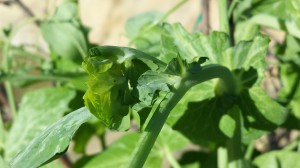
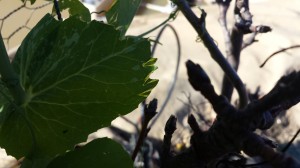
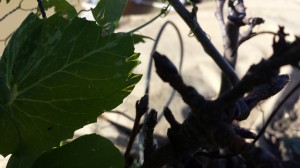
The title is bushtits except that the pictures are of my peas. Peas with funny marks on their leaves. Last year I saw the California towhees eating the new growth buds on my peas and commented here that I should plant more peas because the towhees probably needed something to eat in the winter when there are not a lot of bugs around. Having more insect eating birds to me is a good thing. So this year, I did just that. I spent a whole extra 1.89$ for more pea seeds … for the birds.

When we got rain a little while ago and I was opening up my “tinfoil fruit” I also planted peas around the base of some of my trees.

Something has obviously been munching a bit on them and I was looking at them today and noticed triangular marks… beak marks. Well I think that the marks are beak marks. They are too fine and narrow to be a towhee. My guess is that the marks are from the bushtits which are still around. The thing that amuses me the most is that these peas are at the very tree where I was watching the bushtits hop around right in front of my face, a couple of months ago, eating aphids.
http://www.puravidaaquatic.com/wordpress/bushtits/

Spread the Good News Below: Permaculture!
Posted in Uncategorized | Leave a comment

A big twisted branch

I was looking at a big twisted branch on my pluot tree and realized that it had partially broken and twisted. It seems to me that it probably did it at the same time another branch broke off last year. I had found the branch that broke off last summer when it fell. The branch I was now looking at had almost completely repaired itself. But it was now, sort of rotated about 80 degrees and pointed at the ground. Imagine if standing you had your arm bent slightly and reaching up. Then it broke at your bicep and your hand rotated down about 80 degrees.

The reason the one I had found earlier broke off was the weight of the fruit it had on it last summer. So that’s probably the reason the second one broke as well.

In thinking about that, I wondered if the amount of fruit on a tree might be a wonderful way for the tree to determine how fast it was growing. In other words how good life was.

Now from the tree’s perspective if it is growing extremely well and therefore has a massive amount of fruit on its limbs, probably it has happened to find an extremely good place to be growing. Or maybe its neighbors have suffered a calamity and given it more air, room, and light . So don’t you think it would make sense for the tree to have actually evolved to crack and break its branches and let them sag down into the soil where they would quickly, and with no need to change its genetics, start a new copy of itself? And also to only do this if life was really really good!

Many, many plants can start copies of themselves by developing roots on branches that have come into contact with the soil. This would allow a tree that had found a great spot to reproduce itself much faster than by seed (what most people assume is the only reason for the fruit). Air layering a branch or even starting a cutting generally generates a tree much quicker than from a seed. Maybe there are multiple reasons to have fruit in the first place and also a complex interaction between the strength of a branch and the size of the fruit and the number of potential genetic changes in the offspring (number of fruit).

Trees have had years, and years, and years, and years, and unfathomable years, to perfect little fun genetic tricks like that. And I’ll bet there are thousands of little tricks that they use. Whether the one just hypothesized is among them, who knows. But it was fun thinking about, and I hope you have had fun thinking about it too.

Spread the Good News Below: Permaculture!
Posted in Uncategorized | Leave a comment

Maybe I am NOT a permaculturist

I do not believe that permaculture is about instant gratification. I do not believe it is about who has the biggest or the most swales. I do not believe that it is about asking on a message board for “the permaculture way” to kill things. http://www.puravidaaquatic.com/wordpress/what-is-the-permaculture-way-to-kill-hummingbirds/
I do not believe that it is about my machine being bigger than your machine.
If the above is what permaculture is truly about then the title of this post is correct.

I do believe that the more you know about the world the more beautiful and fascinating it is. I do believe that permaculture revolves around the idea of stop …
look …
and listen.
No really, everyday, stop!

Now look:
At the trees
at the flowers
at the yard
at the sky.

And listen:
To the birds
to the wind
to the things people say.

I do believe that the more you know of biology the more you appreciate the abilities that plants and animals have.

Spread the Good News Below: Permaculture!
Posted in Uncategorized | 1 Comment

Tanglefoot stuff

I am always looking for stuff to help me with my trees __that is not designed to be toxic__ ie. is not a biocide, does not end with the four letters C I D E. Of course they have now renamed algaecide to algaefix :-( . By the way renaming it didn’t change it from being nasty, toxic, and a carcinogen. But renaming it sure works with people who don’t read … the back of the container. :-)

I have used Tanglefoot in the past to prevent ants from climbing up the steel beams into my house which helps me to not use ant poison inside the house. It is a very sticky substance that stays sticky for fairly long periods of time and is used to prevent ants from herding aphids. You smear it around the tree trunk and the ants can’t walk over the stickiness. The aphids are left without protection and the lady bugs get them. Or even the bushtits :-) my kind of aphid control.

Well I was looking at some of my trees and there was some borer damage to a few. Borers are a variety of insects, some are beetles, some are small nats. But they are like leaf miners to the stems, branches, and trunks of trees. The eggs are laid, larvae hatch out, and start feeding on the soft nutrient filled tissues right under the bark. If they chew all the way around they “girdle” the stem and kill everything above the damage. So a fairly minor infestation can in rare instances actually kill a lot of the woody material of a tree.

My neighbors insist that you have to spray insecticide all over the trees to control borers. Now if a tree is healthy it has learned to defend itself by forcing sticky sap into the tunnels that the borers make. If the tree is healthy you sometimes see little sticky worm like extrusions from the bark. The trees pretty much know what they are doing :-) and are reasonably good at it given that they’ve been doing it just a little bit longer than humans have been in existence.

The problem comes about with dwarfing root stocks and other things that cripple trees. Think about it my friends, the only reason a tree is dwarfed is that it is not doing as well as the full sized one. Think about how you make a Bonsai!

There are a lot of claims that it does not affect fruit production but I can guarantee you the tree is not doing as well as normal. So the agrocompanies graft onto a rootstock that cripples a tree and then are pleasantly surprised that it gets sick more often (well the pests have just become more robust right?) and the homeowner has to use more pesticides to keep it healthy. Well, as healthy as possible with a dwarfing rootstock.

One of my purposes in airlayering is to take all my trees back to their own roots. Hey I’ll be able to compare the trees side by side.

Back to the borers. If I could just help a little and prevent some of the borers from coming out it would prevent them from mating, and laying eggs, and help the long term health of my trees. So I have spread a little Tanglefoot around and over some obvious borer damage. We will see. Life is an experiment.

Spread the Good News Below: Permaculture!
Posted in Uncategorized | 3 Comments

Chill hours

Once again it is December, it is cold for a California boy (I think it’s supposed to be 60 tonight), my fruit trees are losing their leaves, and therefore it’s time again to consider chill hours. There is a calculator for California at https://ucanr.edu/chillcalc/index.cfm?controller=station&action=index And it is fun to play with. Still, it is my guess that we have no clue about the actual biological systems that give us a tree setting bloom or not. Certainly cool/cold temperatures are required and yet…. My cherry trees have bloomed every year since I put them in and there is no freaking way we are getting 400 chill hours. 2 years ago I had a tomato plant survive the entire winter and then produce tomatoes in the spring within 20 feet of the cherry … which bloomed and had a good crop of cherries for the squirrels and birds :-) I seriously doubt that a tomato plant can survive 400 chill hours. The funny thing is that my 100 chill hour apples have the toughest time resetting for spring. I would bet that there are several systems that overlap and allow the tree to sense ground temperature, light conditions, air temperature, etc. The cherry and tomato were near my pond and it’s possible that the pond kept the air temperature warm enough for the tomato but the ground temperature got cold enough to reset the cherry. Who knows, my point is that if you have a fruit tree that you want to plant, don’t worry so much about the chill hours required. Plant it, water it, nurture it, and see. Bob 310 429 8477 http://www.PuraVidaAquatic.com

Spread the Good News Below: Permaculture!
Posted in Uncategorized | Leave a comment

Wire mesh and gophers

Like many others I decided I would try putting a layer of chicken wire down to prevent gophers from destroying plants (in my case trees) I tried two different ways and thank goodness I didn’t go whole hog and do a lot because I will never do it again.

What wire mesh does is protect the gophers. They’ve got a safe area that they can burrow under to their hearts content. Nothing can dig down and get them. Coyotes, other predators that might dig, can only reach the wire.

The chicken wire will not last more than 2 or 3 years. Gopher tunnels leading up to it allow oxygen and moisture to cause rust and deterioration even if its galvanized. Then they go right through it even if it is half inch mesh. But they’re still very much protected from any larger predator above. Ever tried to dig up old rusted wire?

Gopher baits are designed to fail in the long run because all the tunnels are still there. A new juvenile gopher moves in and has the run of the entire network which can be quite extensive. So you have to go out and use more bait, which has probably gone bad, so you have to buy some more, and the chemical companies profit.

This is the same problem with chicken wire it protects all the tunnels under the area it covers and if a gopher moves in – even after 5 years they have the entire nest/tunnel system. And digging the wire out! Oh my lord! What a freaking pain! It took me all morning to get it out of about a 10 foot by 10 foot patch!

Chicken wire just encourages you to use poison out of desperation. And think about a snake that eats a poisoned gopher this is a huge percentage meal for a snake I will bet you a _lot_ that the gopher baits have not been tested at this level on reptiles. And why should it be? The chemical companies would love to kill the Gopher predators as well.

It is not a long term solution.

The best thing I have done is to destroy many of the existing gopher runs. I was amazed at how networked such a small area was. I then added compost to my excavations and kaboom – fruit.

That is a long term solution.

Bob
http://www.PuraVidaAquatic.com

Spread the Good News Below: Permaculture!
Posted in Uncategorized | Leave a comment

Ontogeny

Ontogeny recapitulates phylogeny. An observation that a human’s developing embryo goes through stages appearing to be similar to stages in our evolutionary history.

Early on we look like some very early chordates (sort of worm like). [and of course men never grow out of this stage :-) ] Then we look like fish (we even have gills), amphibians, lizards. At later stages we look incredibly like a young chicken. That is so cool, and it just happens to be what our embryos looks like, at least to some, and me too.

But it got me wondering whether the molecular and cellular connections that cause a human embryo to look like an amphibian might be similar enough that they would be sensitive to the chemicals that affect an amphibian or its development. Such as…. http://www.kcet.org/news/redefine/rewild/amphibians-1/central-valley-wildlife-refuges-are-deformed-frog-hotspots.html Hmmmmmmmmmmmmm

Spread the Good News Below: Permaculture!
Posted in Uncategorized | Leave a comment

Air-layering

A couple of months ago I attended a great class offered by the Southern California Rare Fruit Growers Association. It was on air-layering.

Air-layering is a technique to propagate woody trees by tricking them into believing that a branch has been cut off while it is still attached to the tree. This allows the branch to continue receiving water from the main tree so the branch doesn’t wilt. But the branch thinks it has been cut off and tries to grow roots.

I was all enthusiastic, came home, and air-layered a lot of my trees. There were so many, I jokingly refer to them as my tin foil fruit.

I opened up several a couple of months ago and a few had little roots started so I wrapped them back up. I thought that they should “ripen” a while longer. With some light rain predicted for Thursday, I decided I would pot the ones that looked good so I started opening up the tin foil fruit and here is one of the better ones. A lot of them didn’t work but enough did that I’m happy about it for a first time attempt.

Spread the Good News Below: Permaculture!
Posted in Uncategorized | Leave a comment

My Pond

I think often, about how I can live on my property without killing the animals that were already there – even accidentally kill them. That is one of the reasons I spent so much time and effort on my gopher moat. I really enjoy the critter coming and goings. Saw my first fox the other night.

Even the raccoon who has recently decided to bring its significant other to the parties held in my wetland. They turn over every single pot in my plant growing area. I’ll bet they are looking for snails or aquatic worms under them. But they aren’t very careful and they don’t set them back up when they’re done :-) Sigh.

I may end up getting an infrared motion detection sprinkler system. It is fairly effective at keeping them away — they don’t like being sprayed. Just like a cat. Which seems sort of funny because they like wading around in the water so much. So maybe I’ll get one and put it in that one area. My sort of solution … nontoxic non-lethal :-) and they can still visit the other areas of the wetland and pond all they want.

Because I enjoy the critters, I made my pond (pond0) sloped in _and_ out. Inside there is a long sloping section that leads out and it is also quite useful for putting plants at different water levels. All the animals can get in and out. bugs, mice, lizards snakes,… me! The birds love that area as a landing pad. That is why I think I had the toads breeding in there last year. The chorus frogs can climb into practically any bit of water anywhere but the toads don’t jump that well and certainly don’t have sticky pads to climb out once they are in. Boy, I really hope they are back this year.

I wish I could encourage other people who are building a pond to make it so that the native wildlife can use it better. I am so glad that the blog readers here and members of SanDiego Permaculture Meetup care about living with the world instead of against it. And that they feel along with me that permaculture is not about instant gratification.

Permaculture is not about digging a swale on your property just to be able to say “I have a swale”, but instead it’s about using your brain before you do something. Using your brain and asking yourself is this living with the world. And for me, sometimes using my brain means that I have to stop, look, and listen — in order to fully appreciate the roses :-)

Spread the Good News Below: Permaculture!
Posted in Uncategorized | 1 Comment

Www.Californiaherps.com

So I just spent a couple of hours exchanging several emails with a wonderful guy who has the website www.Californiaherps.com He is very knowledgeable and has a lot of information on his website that will help one identify a snake or a lizard, turtle, toad, frog, et cetera . He also has a very useful section on the california laws regarding the touching, poking, killing, and collecting of native reptiles and amphibians. In short it’s pretty much against the law to bother them, which I think is great. So if you find a snake, frog, lizard, or toad on your property take a picture of it and go to his website to idenify it, but do your best to leave it alone. And I’ll bet your karma will reward you.

Spread the Good News Below: Permaculture!
Posted in Uncategorized | Leave a comment