Pyrethrins: Safe? Pesticides

en.m.wikipedia.org/wiki/Pyrethrin

Aquatic habitats : In aquatic settings, toxicity to pyrethrin fluctuates, increasing with rising temperatures, water, and acidity. Run-off after application has become a concern for sediment-dwelling aquatic organisms because pyrethroids can accumulate in these areas.[32] Aquatic life is extremely susceptible to pyrethrin toxicity,

Bees: Pyrethrins are applied broadly as non-specific insecticides. Bees have been shown to be particularly sensitive to pyrethrin, with fatal doses as small as 0.02 micrograms.[35] Due to this sensitivity and pollinator decline, it is recommended that pyrethrins be applied at night in order to avoid typical pollinating hours, and in liquid rather than dust form.

Please please in this rainy season be careful of applying any toxin, biocide, etc that can wash into streams, ponds, wetlands, etc. Please be especially careful of neem oil.

Bob
www.PuraVidaAquatic.com

Spread the Good News Below: Permaculture!
Posted in Uncategorized | 1 Comment

The Dark Secrets of the Bird World – Wait But Why

What do you find when you look behind the curtain of the bird world?

Source: The Dark Secrets of the Bird World – Wait But Why

Yes why :-)

Spread the Good News Below: Permaculture!
Posted in Uncategorized | Leave a comment

Chemistry :-)

Chemistry is a language. I will bet that in the future people with good native language skills will do very well in chemistry. I hated chemistry in college but I loved biology and subsequently microbiology and I realized that I would have to force myself :-) . So I learned a bit about chemistry during my PhD work on DNA damage and repair. I am unfortunately not the most at ease with languages other than English.

Acetone is C3H6O. Our own bodies make it. It is a natural chemical. Our cells make it in very small amounts though.

It is true that the solution to pollution is dilution. People worry a lot about plastic and the tiny, tiny amounts of problematic chemicals in it and are completely blind to the vastly larger amounts of toxic chemicals that they expose themselves to in other activities.

I also find it questionable to concentrate something -even a biological compound- ten, a hundred, a thousand fold and use it without question because it is natural. So is acetone but you really wouldn’t want to bathe in it, or breathe it, or drink it or … And while I am sure that there are many beneficial essential oils, I am hesitant to become too trusting.

But I do know that the biocide neem oil is one of the most toxic compounds available on the market today.  There is a reason that it is a good fungicide and is bactericidal just like a Roundup. It will not be kind to your intestinal flora just like Roundup. It is highly toxic in aquatic environments just like Roundup. Think dragonflies, damselflies and many other mosquito predators.

Neem products are toxic to:
Beneficial soil nematodes, Beneficial soil fungi, beneficial soil bacteria just like Roundup
Beneficial soil insects such as springtails.

Neme products harm small aquatic crustaceans just like Roundup — what do you think a baby dragonfly eats?
Neem products have been shown to be toxic to:
Bees, Ladybugs, and many other beneficial insects

It took decades to find out all the toxic issues with Roundup. It is likely that neem oil is as bad as Roundup we just don’t know it yet. But our chemical company PR departments have convinced organic gardeners and permacultures that neem oil is safer than Apple pie and the American flag. Please do not use it or allow your gardeners to do so.

On another chemistry note: Based on research completed at the United States Environmental Assessment Center, (www.dhmo.org)

Hydric acid (aka. dihydrogen monoxide) :
•is the major component of acid rain.
•contributes significantly to the Greenhouse Effect.
•may cause severe burns.
•accelerates corrosion and rusting of many metals.
•may cause electrical failures and decreased effectiveness of automobile brakes.
•has been found in excised tumors of terminal cancer patients.

Additionally, dihydrogen monoxide is found in many of the foods we eat, used as a solvent in most pesticides and is very difficult to be removed from most biological systems.

And, from my own research work:
•upon partial decomposition it generates hydroxyl radical one of the most toxic oxidants known. And a significant carcinogen.
•generates highly explosive gases upon full decomposition.

Two separate studies found that 86% and 90% of Americans, respectively, felt that they would in fact sign a petition and support an outright ban on dihydrogen monoxide.

And if you find the above appalling, please! feel free to comment.

And I love reading the Onion. It is a news publication that investigates many of the issues in today’s society I encourage you to look it up and read carefully.


I might have been too subtle there.  Knowledge and reading is a really good thing. Dihydrogen monoxide is H2…. O (water) 86% and 90% of people questioned would vote to  ban it.  Please, please, please, if you want to be a permaculturist start by learning some basic chemistry. You cannot think critically about a pesticide label unless you learn something about the chemicals in it. Take a minute to read carefully and think.

Then stop.
Look.
And listen.

The very best to you all
Bob

Best to you all.
www.PuraVidaAquatic.com

Spread the Good News Below: Permaculture!

Posted in Uncategorized | 1 Comment

Neonicotinoid pesticides are bad news for everything | New Scientist

First it was the bees, now a major report suggests a host of wildlife is being harmed by the widely-used neonicotinoid pesticides

Source: Neonicotinoid pesticides are bad news for everything | New Scientist

The chemicals break down more slowly than early tests suggested, says author Jeroen van der Sluijs of Utrecht University in the Netherlands. These past studies, which informed the decision to allow the use of neonicotinoids, looked mostly at immediate effects. But long-term environmental build-up may be the real problem, so the task force says the previous regulatory studies “lack environmental relevance”.

The European Union has imposed a two-year moratorium on neonicotinoids, but their half-life in soil can be three years

There are many small insects that contribute greatly to the biological activity of soil, and breakdown and release of soil nutrients. The myrad of tiny insects will certainly be poisoned as well.

Great

Spread the Good News Below: Permaculture!

Posted in Uncategorized | Leave a comment

Center for Biological Diversity and the new EPA bee report

Source: biologicaldiversity.org/news

These systemic insecticides cause entire plants, including pollen and fruit, to become toxic to pollinators; they are also slow to break down, and thus they build up in the environment.

Here it says the neonicotinoid pesticides are slow to break down. Other sources say their half life is two to three years. That means in 6 years a quarter of what you put on today will still be present,

There will be slightly more than a quarter of what you put on next year added to that.

Half of what you put on in three years on top of that again, …2 years, …last year. In six years the soil load will be twice the application amount and since many of these studies are funded by industry. An industry that wants to minimize problems, my guess is that they took the best case scenario for the half life. OMG.

Spread the Good News Below: Permaculture!
Posted in Uncategorized | Leave a comment

Gopher trenches win again

I had busted my tail trying to keep my trees away from the gophers without poisoning them. My ex significant other – who donated the liquid plumber to my constructed wetland – was extremely annoyed that I was spending the time and effort.

And I always questioned myself whether it had been worth it. But this morning I went down and and in looking around realized that even with the heavy rain practically all the water rushing down my asphalt driveway had gone into the trenches and not onto the street

The more I looked at the trenches the more I realized how much water had gone into them. There’s 200 feet of trench that’s a foot wide and maybe a foot and a half deep and there was water flooded all the way to the end of them. Some of the weeds in the bottom of the trench, even all the way at the end, were squashed flat by the rushing water. And all that water is now soaked into the ground in and around my orchard.

Bob

www.PuraVidaAquatic.com

Spread the Good News Below: Permaculture!
Posted in Uncategorized | Leave a comment

Water Math

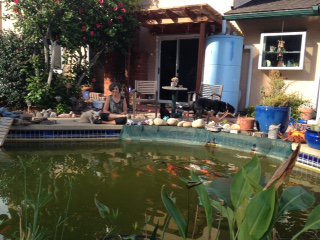
I paced off the amount of my property that does not have rain water catchment and flows onto the street as 420 square feet which is 1% of an acre

My property is four acres so that means 0.25% of my water ran onto the street. That also means that with 6 inches of rain in 3 days (which is the measurement from my buckets) I captured a total of 651,702gal minus the 1,629 which ran onto the street. Which is completely ignoring any of that street water soaking in on its own as it went.

If we subtract 8,073 gallons that went into my pond, that is 642,000 gallons that soaked into the ground. And all of that water was free of pesticide contamination. All you people on wells owe me :-). And I also think I paid my food water bill this year.

A lot of the water soaked in due to my hugelkulture. The pond overflow goes to a large system.

My Water District pumps water up to our area from the reservoir and there is an electricity surcharge, so my 8,073 pond gallons of water doesn’t have to be pumped back up from the reservoir down below to be used by me on my orchard. yay

Bob

Spread the Good News Below: Permaculture!
Posted in Uncategorized | Leave a comment

Podcasts with Diane Kennedy

Here is a recent post from Diane’s facebook page

Source: Podcasts with Diane Kennedy

Two podcasts with me talking about permaculture, Finch Frolic Garden, and how you can save money and the world through gardening! :) Please let me know what you think:

Spread the Good News Below: Permaculture!
Posted in Uncategorized | Leave a comment

Dinosaurs may have done bird-like dances to attract mates

Some dinosaurs may have engaged in courtship rituals similar to ostriches and other birds, a finding that could shed light on the poorly understood mating behavior of these giants.

Source: Dinosaurs may have done bird-like dances to attract mates

Williamson said that it is suspected that dinosaurs must have had “a rich repertoire of behaviors related to mating and/or territoriality” based on the “elaborate skull ornamentation, colored plumage, and other structures that many dinosaurs have.”

And if you haven’t watched the birds of paradise recently watch them again :-)
Birds of Paradise

Even the announcer in the YouTube video above says that the New Guinea birds of paradise are “unique and evolved nowhere else.”  “One of the singular events of evolution that is so unique” Laughing, maybe that is an inside the box way of looking at it. Maybe many dinosaurs and early birds were like the birds of paradise today. They had evolved for millions and millions of years with feathers.  Certainly that would be enough time to modify a color or two. But it’s not just the colors and the fantastic exaggeration of some of the feathers. It’s the dance patterns, the tapping, the vocalisations that are fascinating to me and that I imagine evolving with the dinosaurs. Call me crazy :-) this is also what I refer to as the neurological evolution that is required before a jump in physical structure.  The neurological evolution is never fossilized and leads to the pauses in evolution.

And it is just possible that the reason that the birds of paradise are now only found in a small area of New Guinea is _not_ that they could only evolve there but that the competition to survive after the asteroid impact wiped out that behavior everywhere else as too expensive.

I so want someone to paint me a picture of a triceratops covered with beautiful iridescent feathers with even more elaborate feathers around the frill of its head, and — Dancing!

I have no money to pay for it though. Oh well.

Spread the Good News Below: Permaculture!
Posted in Uncategorized | Leave a comment

Berkeley Sues Monsanto for PCB Pollution

The council’s 6-0 vote on Tuesday means that Berkeley is joining Oakland, San Jose, San Diego and Spokane, Washington, in filing suits against Monsanto, an agricultural biotech company based in St. Louis.

Source: Berkeley Sues Monsanto for PCB Pollution

Worthington said, “Monsanto’s polluting proliferation of PCBs was a corporate crime and restitution for this nefarious nuisance should come from Monsanto’s profits, not from the taxpayers’ pockets.”

I like the phrase “corporate crime”

Bob

Spread the Good News Below: Permaculture!
Posted in Uncategorized | Leave a comment