
This gallery contains 1 photo.
So do you think my cherry tree got 800 chill hours last year? Because that is what it is supposed to need to set bloom. Not a chance. Some of the new thinking on chill hours is that they reset … Continue reading
This gallery contains 1 photo.
So do you think my cherry tree got 800 chill hours last year? Because that is what it is supposed to need to set bloom. Not a chance. Some of the new thinking on chill hours is that they reset … Continue reading
But Mrs. Josephine Rabbit, and his sisters, Flopsy, Mopsy, and Cotton-tail are under my orange tree.
Do you know how hard it is to get a picture of 3 baby rabbits that all want to go in different directions and hide their faces?




Go ahead.
by voice recognition on bob’s droid. Sorry for the Weird capitalization. Website http://www.puravidaaquatic.com/
http://independentnewshub.com/?p=97715
Bad news, bees. Two new studies found that two separate pesticides adversely af the part of a bee’s brain that is responsibly for its ability to learn, and when used combination the effects are even worse. It turns out spraying things with poisonous chemicals might have side effects. Who knew? The pesticides in question are a type of chemical used on crops called neonicotinoids, another type used on beehives themselves to protect bees from the parasitic Varroa m called coumaphos. Besides showing the obvious disadvantage of a bunch of dumb bees flying around, th studies are also the first to show the direct affect of pesticides on pollinators like bees their brain physiology. The studies were done by exposing bees brains to the chemica way similar to how they are used in agricultural settings. As many as 30% of the expos bees showed a failure to learn, or under-performed at a memory test. The researchers behind the studies have expressed concern over the use of chemicals affect non-target species in a negative way. Besides failing memory tests, stupid bees forget things like where their hive is, or how to pollinate things, and that’s really the w point of bees in the first place. (via Phys.Org, image via @Doug88888)
Wonderful! And since we know so well that these insecticides just couldn’t affect the _human_ brain…
And since we also know so clearly how the chemicals break down in the environment and that a breakdown product of these chemicals couldn’t possibly have different bee vs human specificity we are all safe!
Don’t you feel good now.
Anybody read the story about how bees generate a positive electrostatic charge while they’re flying? The flowers have a negative charge! When the bee lands on the flower it neutralizes the 2 charges and the flower remains neutral to positive for 30 seconds or so. The Bees can see the charge and not revisit the same flower on their flight.
That is so cool! Bees can see an electrostatic charge!
And pesticides although they are neurotoxins don’t cause any harm to humans. That is if you believe the manufacturers of those items.
Of course we will not be able to show that Pesticides do not cause autism, or dementia, or Alzheimer’s, or ADHD because there are no people in America anymore who are not exposed to pesticides ie. “don’t smoke”. Think for a moment how much data there was to show that cigarettes cause cancer. There was virtually a mountain of data showing a link between cigarettes and cancer. And yet the lawyers and CEOs of the tobacco companies were successful for many many years in preventing any kind of legislation that would protect the rest of us from all the cigarette smoke. simply because they insisted that Cigarettes were harmless.
The mountain of data to the contrary came from comparing the medical conditions of people who did smoke with those who didn’t smoke. Please show me someone in or near a large American city who is not exposed to pesticides.
Or even outside America. We are exporting DDT to third world countries. it’s going to be really easy for the chemical companies to insist that the pesticides don’t harm us when there is no data comparing people in pesticide free zones with people in pesticides zones. We need to have pesticide free zones in America.
Breakdown products — we have no clue as to the effects of the break down products of many of these chemicals. Is it possible that companies could be required to spend it a portion of their sales on independent studies of breakdown products and possible consequences? As of today only one side of the equation is being funded. It’s impossible to have a fair discussion when that is the case.
Good article. But one of the advantageous things about a constructed wetland is it is not just the bacteria. It is about all the little microenvironments and ecosystems.
Instead of taking drugs for Alzheimer’s why don’t you do a little Alzheimer’s prevention yourself and put a tiny portion of the money that you would have spent on drugs into a night school class. An adult education class. Don’t sit in front of the computer actually go to an adult education class in your community and meet your neighbors!!! Who are also interested.
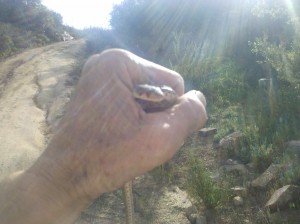
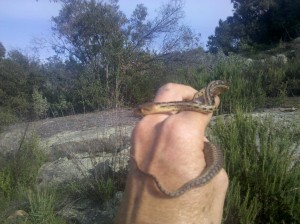
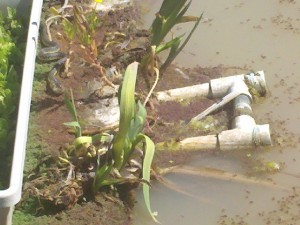
I pulled my seedling flotation system over to the side of the pond to take a look at it and what was staring back at me was ….
Upper left of center. A small garter snake with 1 of the huge tadpoles. That tadpole was at least twice probably three times as big as the garter snakes head. But it kept working at it and maybe a minute later it had it down.
Well I don’t feel too bad for my day’s work of turning some sunlight and rain water into garter snake. Ahhhh it was a tough job. I think I’ll go have a beer :-)
http://hereandnow.wbur.org/2013/03/22/monarch-butterflies-dying
Over half gone! If half the hummingbirds suddenly died there’d be an outcry like you wouldn’t believe. All the major news media would pick it up. I don’t know whether it’s in the posted story or not but in the interview it was suggested that the spraying of Roundup in the Midwest was partially to blame. Roundup much more effectively obliterates all of the milkweed in an area as opposed to tilling.
But people just don’t care about bugs. Sigh
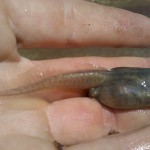
They are getting legs and getting bigger. I have never seen bullfrog tadpoles which are reported to get up to 6 inches long but these are the biggest tadpoles I’ve seen. They are nearly 3 inches. In addition they are amazingly pudgy. I don’t know whether this picture shows it very well but the bronze color is almost iridescent. I don’t think they have cheeks the way we do but it looks as though they have marbles in their mouth or very fat cheeks. Their eyes are pretty interesting as well.
End end